

(function () {
function textOf(el) {
return (el && el.textContent || "").replace(/\s+/g, " ").trim();
}
function resolveItemUrl() {
var match = window.location.search.match(/[?&]item=(\d+)/);
if (!match) {
return null;
}
return window.location.origin + "/a-" + match[1] + "/";
}
function loadAccordion() {
var url = resolveItemUrl();
if (!url) {
return Promise.resolve(null);
}
return new Promise(function (resolve, reject) {
var xhr = new XMLHttpRequest();
xhr.open("GET", url, true);
xhr.onload = function () {
if (xhr.status < 200 || xhr.status >= 400) {
reject(new Error("item page " + xhr.status));
return;
}
var doc = new DOMParser().parseFromString(xhr.responseText, "text/html");
resolve(doc.querySelector(".phywe-item-accordion"));
};
xhr.onerror = function () {
reject(new Error("item page network error"));
};
xhr.send();
});
}
function parseItemBlocks(scope, withQuantity) {
if (!scope) {
return [];
}
var rows = scope.querySelectorAll(".itemslist .row.itemblocks");
var items = [];
for (var i = 0; i < rows.length; i++) {
var cols = rows[i].children;
if (!cols.length) {
continue;
}
var nameLink = cols[0].querySelector("a");
var numberLink = cols[1] ? cols[1].querySelector("a") : null;
var item = {
name: textOf(nameLink || cols[0]),
mappedTo: textOf(numberLink)
};
if (withQuantity && cols[2]) {
var qty = parseInt(textOf(cols[2]).replace(/[^\d]/g, ""), 10);
item.quantity = isNaN(qty) ? textOf(cols[2]) : String(qty);
}
if (item.name) {
items.push(item);
}
}
return items;
}
function fillTable(tableId, items, withQuantity) {
var table = document.getElementById(tableId);
if (!table || !items.length) {
return;
}
var tbody = table.querySelector("tbody");
for (var i = 0; i < items.length; i++) {
var tr = document.createElement("tr");
var nameTd = document.createElement("td");
nameTd.style.width = "80%";
nameTd.textContent = items[i].name;
tr.appendChild(nameTd);
var numberTd = document.createElement("td");
numberTd.textContent = items[i].mappedTo;
tr.appendChild(numberTd);
if (withQuantity) {
var qtyTd = document.createElement("td");
qtyTd.textContent = items[i].quantity || "";
tr.appendChild(qtyTd);
}
tbody.appendChild(tr);
}
var wrapper = table.parentElement;
while (wrapper && wrapper.className.indexOf("printtablediv") === -1) {
wrapper = wrapper.parentElement;
}
if (wrapper) {
wrapper.style.display = "";
}
}
function stepTitle(stepEl) {
if (!stepEl) {
return "";
}
var titleEl = stepEl.querySelector(".card-header button div") || stepEl.querySelector(".card-header button");
return textOf(titleEl);
}
function setHeadline(tableId, title) {
var headline = document.querySelector("#" + tableId + " .printtableheadline");
if (headline && title) {
headline.textContent = title;
}
}
function parseMedia(scope) {
if (!scope) {
return [];
}
var rows = scope.querySelectorAll(".itemslist .row.itemblocks");
var items = [];
for (var i = 0; i < rows.length; i++) {
var cols = rows[i].children;
if (!cols.length) {
continue;
}
var nameLink = cols[0].querySelector("a");
var fileLink = cols[1] ? cols[1].querySelector("a") : null;
var item = {
name: textOf(nameLink || cols[0]),
mappedTo: textOf(fileLink || cols[1]),
quantity: cols[2] ? textOf(cols[2]) : ""
};
if (item.name) {
items.push(item);
}
}
return items;
}
function fillFromAccordion(accordion) {
if (!accordion) {
return;
}
var versucheStep = accordion.querySelector('[data-step="versuche"]');
var versuche = parseItemBlocks(versucheStep, false);
setHeadline("print-versuche", stepTitle(versucheStep));
fillTable("print-versuche", versuche, false);
var lieferumfangStep = accordion.querySelector('[data-step="lieferumfang"]');
var lieferumfang = parseItemBlocks(lieferumfangStep, true);
fillTable("print-lieferumfang", lieferumfang, true);
var zubehoer = accordion.querySelector('[data-step="zubehoer"]');
var sections = zubehoer ? zubehoer.querySelectorAll(".card-body") : [];
var notwendig = [];
var empfohlen = [];
for (var i = 0; i < sections.length; i++) {
var items = parseItemBlocks(sections[i], false);
if (sections[i].querySelector(".text-red, .icon-warning-black")) {
notwendig = items;
} else if (sections[i].querySelector(".text-green, .icon-Mehrwert_black")) {
empfohlen = items;
}
}
fillTable("print-zubehoer-notwendig", notwendig, false);
fillTable("print-zubehoer-empfohlen", empfohlen, false);
var mediaStep = accordion.querySelector('[data-step="media"]');
var media = parseMedia(mediaStep);
setHeadline("print-media", stepTitle(mediaStep));
fillTable("print-media", media, true);
}
function start() {
var itemUrl = resolveItemUrl();
if (!itemUrl) {
setTimeout(function () {
window.print();
}, 2000);
return;
}
loadAccordion()
.then(function (accordion) {
fillFromAccordion(accordion);
})
.catch(function (err) {
if (window.console && console.warn) {
console.warn("Accordion konnte nicht geladen werden:", resolveItemUrl(), err);
}
})
.then(function () {
setTimeout(function () {
window.print();
}, 500);
});
}
if (document.readyState === "loading") {
document.addEventListener("DOMContentLoaded", start);
} else {
start();
}
})();
Technical data Oblique Projectile Motion with Cobra DigiMotionArticle no: P6213000 ![]() Principle Projectile motion is a classical type of motion in mechanics. The motion consists of two independent components: a uniform motion in the horizontal direction and a uniformly accelerated motion in the vertical direction. The superposition of these two motions results in a parabolic trajectory. Gravity acts exclusively in the vertical direction and determines how quickly the object falls to the ground. The initial horizontal velocity, on the other hand, only affects the range of the object. In an idealized model without air resistance, every object follows the same trajectory, whereas air resistance and friction reduce the range in real-world conditions. With the MotionBoard, the trajectory of the MotionDot can be recorded and analyzed precisely in real time. Tasks
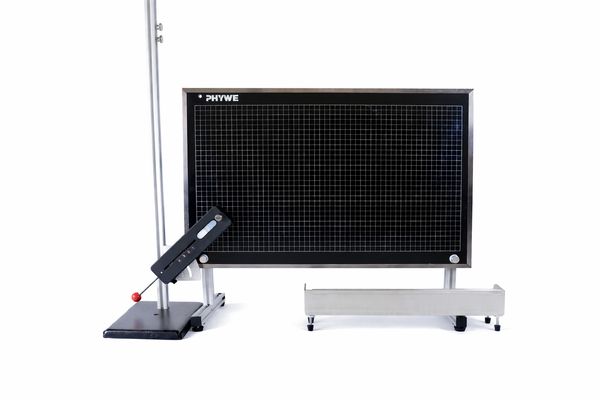
Learning objective Learners should first recognize that projectile motion consists of a uniform horizontal motion and a uniformly accelerated vertical motion. For this purpose, an object is launched with a defined initial velocity and its trajectory is recorded using the MotionBoard. Students should become familiar with the concepts of horizontal and vertical motion, velocity, acceleration, and parabolic trajectory. From the beginning of their study of kinematics, they should be able to decompose motions into their components, determine trajectories, and evaluate measurement data graphically. Benefits
|

