 Service

Technical data Free Fall with Cobra DigiMotionArticle no: P6214000 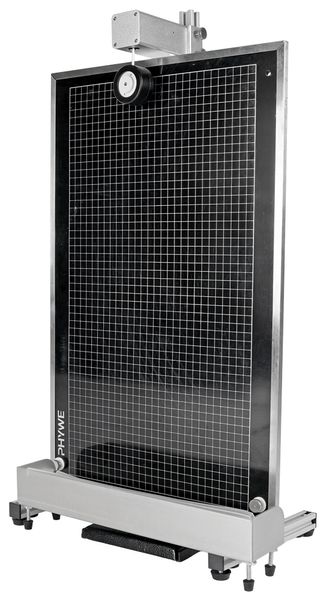 Principle Free fall can be observed everywhere in everyday life whenever objects fall to the ground. Historically, the development of the theory of gravitation is often associated with Isaac Newton. In the ideal case, the only force acting on a falling object in the Earth's gravitational field is its weight, causing it to accelerate uniformly. In reality, air resistance influences the motion. The larger the surface area and the lower the density of an object, the greater the braking effect. In this experiment, air resistance and buoyancy are neglected so that a uniformly accelerated motion can be investigated. Using the MotionBoard, the fall of a MotionDot is recorded in real time, making it possible to determine the acceleration due to gravity experimentally. Tasks
Learning objective Learners should first recognize that an object in free fall performs a uniformly accelerated motion. To achieve this, a MotionDot is dropped from different heights and its motion is recorded using the MotionBoard. Students should become familiar with the concepts of velocity, acceleration, potential energy, and kinetic energy. From the beginning of their study of mechanics, they should be able to analyze measurement data and experimentally determine the acceleration due to gravity. Benefits
|
PHYWE Systeme GmbH & Co. KG
Robert-Bosch-Breite 10 – 37079 Göttingen – Germany
www.phywe.com
Robert-Bosch-Breite 10 – 37079 Göttingen – Germany
www.phywe.com