 Service

Technical data Circular Motion with Cobra DigiMotion Expert SetArticle no: P6216000 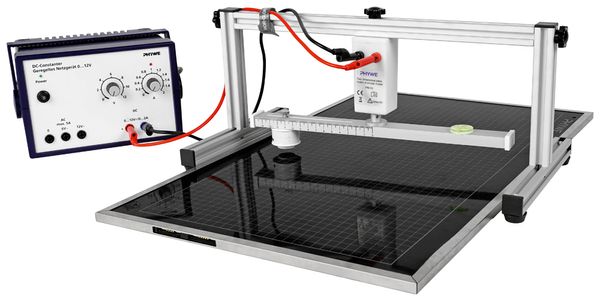 Principle Uniform circular motion describes the movement of an object along a circular path at constant speed. To maintain the circular motion, a centripetal force directed toward the center continuously acts on the object, changing the direction of the velocity without altering its magnitude. In everyday life, uniform circular motion can be observed in rotating carousels, fan blades, or Ferris wheel cabins. Although the speed remains constant, the direction of motion changes continuously. The kinetic energy therefore remains constant, while the velocity vector is continuously adjusted to follow the circular path. For the same speed, a smaller radius results in a higher frequency, whereas a larger radius leads to a lower frequency. With the MotionBoard, the motion can be recorded and analyzed with high precision. Tasks
Learning objective Learners should recognize that an object moving along a circular path experiences continuous acceleration even though its speed remains constant, because the direction of motion is constantly changing. They should become familiar with the concepts of radius, frequency, angular velocity, tangential speed, velocity, and acceleration. From the beginning of their study of mechanics, they should be able to measure circular motion, determine the period and tangential speed, and analyze the relationships between frequency, angular velocity, tangential speed, and radius. Benefits
|
PHYWE Systeme GmbH & Co. KG
Robert-Bosch-Breite 10 – 37079 Göttingen – Germany
www.phywe.com
Robert-Bosch-Breite 10 – 37079 Göttingen – Germany
www.phywe.com