

(function () {
function textOf(el) {
return (el && el.textContent || "").replace(/\s+/g, " ").trim();
}
function resolveItemUrl() {
var match = window.location.search.match(/[?&]item=(\d+)/);
if (!match) {
return null;
}
return window.location.origin + "/a-" + match[1] + "/";
}
function loadAccordion() {
var url = resolveItemUrl();
if (!url) {
return Promise.resolve(null);
}
return new Promise(function (resolve, reject) {
var xhr = new XMLHttpRequest();
xhr.open("GET", url, true);
xhr.onload = function () {
if (xhr.status < 200 || xhr.status >= 400) {
reject(new Error("item page " + xhr.status));
return;
}
var doc = new DOMParser().parseFromString(xhr.responseText, "text/html");
resolve(doc.querySelector(".phywe-item-accordion"));
};
xhr.onerror = function () {
reject(new Error("item page network error"));
};
xhr.send();
});
}
function parseItemBlocks(scope, withQuantity) {
if (!scope) {
return [];
}
var rows = scope.querySelectorAll(".itemslist .row.itemblocks");
var items = [];
for (var i = 0; i < rows.length; i++) {
var cols = rows[i].children;
if (!cols.length) {
continue;
}
var nameLink = cols[0].querySelector("a");
var numberLink = cols[1] ? cols[1].querySelector("a") : null;
var item = {
name: textOf(nameLink || cols[0]),
mappedTo: textOf(numberLink)
};
if (withQuantity && cols[2]) {
var qty = parseInt(textOf(cols[2]).replace(/[^\d]/g, ""), 10);
item.quantity = isNaN(qty) ? textOf(cols[2]) : String(qty);
}
if (item.name) {
items.push(item);
}
}
return items;
}
function fillTable(tableId, items, withQuantity) {
var table = document.getElementById(tableId);
if (!table || !items.length) {
return;
}
var tbody = table.querySelector("tbody");
for (var i = 0; i < items.length; i++) {
var tr = document.createElement("tr");
var nameTd = document.createElement("td");
nameTd.style.width = "80%";
nameTd.textContent = items[i].name;
tr.appendChild(nameTd);
var numberTd = document.createElement("td");
numberTd.textContent = items[i].mappedTo;
tr.appendChild(numberTd);
if (withQuantity) {
var qtyTd = document.createElement("td");
qtyTd.textContent = items[i].quantity || "";
tr.appendChild(qtyTd);
}
tbody.appendChild(tr);
}
var wrapper = table.parentElement;
while (wrapper && wrapper.className.indexOf("printtablediv") === -1) {
wrapper = wrapper.parentElement;
}
if (wrapper) {
wrapper.style.display = "";
}
}
function stepTitle(stepEl) {
if (!stepEl) {
return "";
}
var titleEl = stepEl.querySelector(".card-header button div") || stepEl.querySelector(".card-header button");
return textOf(titleEl);
}
function setHeadline(tableId, title) {
var headline = document.querySelector("#" + tableId + " .printtableheadline");
if (headline && title) {
headline.textContent = title;
}
}
function parseMedia(scope) {
if (!scope) {
return [];
}
var rows = scope.querySelectorAll(".itemslist .row.itemblocks");
var items = [];
for (var i = 0; i < rows.length; i++) {
var cols = rows[i].children;
if (!cols.length) {
continue;
}
var nameLink = cols[0].querySelector("a");
var fileLink = cols[1] ? cols[1].querySelector("a") : null;
var item = {
name: textOf(nameLink || cols[0]),
mappedTo: textOf(fileLink || cols[1]),
quantity: cols[2] ? textOf(cols[2]) : ""
};
if (item.name) {
items.push(item);
}
}
return items;
}
function fillFromAccordion(accordion) {
if (!accordion) {
return;
}
var versucheStep = accordion.querySelector('[data-step="versuche"]');
var versuche = parseItemBlocks(versucheStep, false);
setHeadline("print-versuche", stepTitle(versucheStep));
fillTable("print-versuche", versuche, false);
var lieferumfangStep = accordion.querySelector('[data-step="lieferumfang"]');
var lieferumfang = parseItemBlocks(lieferumfangStep, true);
fillTable("print-lieferumfang", lieferumfang, true);
var zubehoer = accordion.querySelector('[data-step="zubehoer"]');
var sections = zubehoer ? zubehoer.querySelectorAll(".card-body") : [];
var notwendig = [];
var empfohlen = [];
for (var i = 0; i < sections.length; i++) {
var items = parseItemBlocks(sections[i], false);
if (sections[i].querySelector(".text-red, .icon-warning-black")) {
notwendig = items;
} else if (sections[i].querySelector(".text-green, .icon-Mehrwert_black")) {
empfohlen = items;
}
}
fillTable("print-zubehoer-notwendig", notwendig, false);
fillTable("print-zubehoer-empfohlen", empfohlen, false);
var mediaStep = accordion.querySelector('[data-step="media"]');
var media = parseMedia(mediaStep);
setHeadline("print-media", stepTitle(mediaStep));
fillTable("print-media", media, true);
}
function start() {
var itemUrl = resolveItemUrl();
if (!itemUrl) {
setTimeout(function () {
window.print();
}, 2000);
return;
}
loadAccordion()
.then(function (accordion) {
fillFromAccordion(accordion);
})
.catch(function (err) {
if (window.console && console.warn) {
console.warn("Accordion konnte nicht geladen werden:", resolveItemUrl(), err);
}
})
.then(function () {
setTimeout(function () {
window.print();
}, 500);
});
}
if (document.readyState === "loading") {
document.addEventListener("DOMContentLoaded", start);
} else {
start();
}
})();
Technical data Centrifugal Motion with Cobra DigiMotion Expert SetArticle no: P6217000 ![]() Principle In vertical circular motion, an object moves along a circular path. Its velocity is always tangential to the path, while the centripetal force pulls the object toward the center of the circle. In addition, gravity acts vertically and changes the object's speed along the path. At the highest point, the speed must be sufficient for the object to complete the entire trajectory. This makes it possible to investigate the initial conditions that the MotionDot must satisfy in order to reach the highest point of the circular path. With the MotionBoard, the trajectory can be recorded with high precision. Tasks
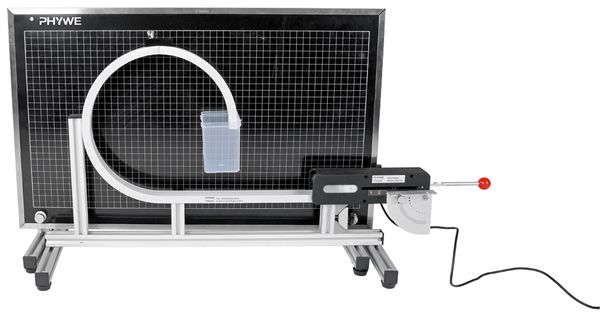
Learning objective Learners should recognize that vertical circular motion results from the combination of tangential velocity and centripetal force, while gravity changes the speed along the path. They should become familiar with the concepts of centripetal force, centrifugal force, kinetic energy, potential energy, and inertial reference frames. From the beginning of their study of mechanics, they should be able to analyze forces acting on an object, compare trajectories, and recognize energy transformations along the path. Benefits
|

