 Service

Technical data Energy Conversion and Differential Weighing in Electrolysis with Cobra SMARTsense EnergyArticle no: P7403069 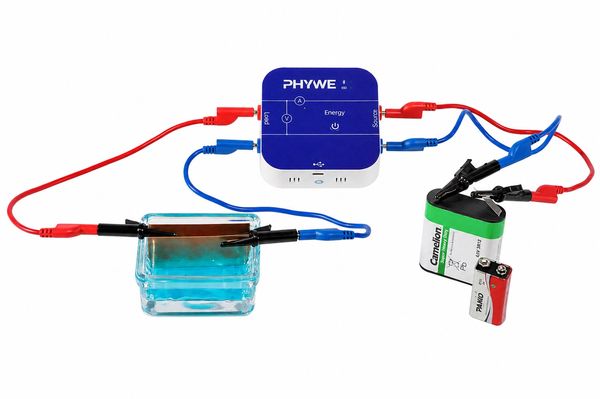 Principle In this experiment, students investigate electrolysis using copper as an example. Two (metallic) copper electrodes are immersed in a copper sulfate solution (electrolyte) and connected to a DC voltage source. Students verify that electrolysis is a redox reaction in which electrons are transferred from one substance to another, resulting in the formation of elemental substances. Electrons flow from the anode to the cathode. Cations from the electrolyte migrate to the cathode and gain electrons, while anions migrate to the anode and lose electrons. Tasks
Learning objectives Students understand the principle of electrolysis and can explain the relationship between electric current and chemical reactions. They also gain hands-on experience with Faraday’s First Law and verify its validity. In addition, they recognize how different current strengths affect energy consumption and the efficiency of electrolysis. Benefits
|
Robert-Bosch-Breite 10 – 37079 Göttingen – Germany
www.phywe.com

