 Service

Also part of:
Principle
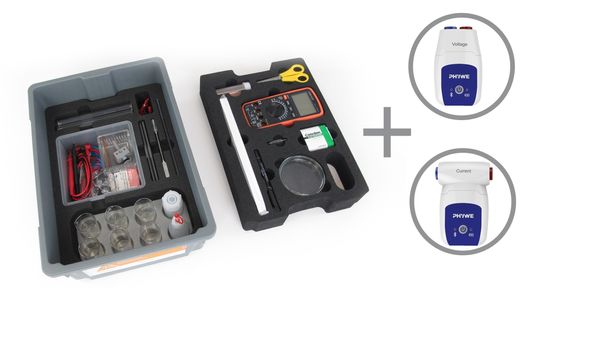
In this experiment, students investigate electrolysis using copper as an example. Two (metallic) copper electrodes are immersed in a copper sulfate solution (electrolyte) and connected to a DC voltage source. Students verify that electrolysis is a redox reaction in which electrons are transferred from one substance to another, resulting in the formation of elemental substances. Electrons flow from the anode to the cathode. Cations from the electrolyte migrate to the cathode and gain electrons, while anions migrate to the anode and lose electrons.
Tasks
- How can a metal be deposited using electric current?
- Set up an electrolysis apparatus and start the electrolysis.
- Measure the voltage and observe what happens at both electrodes.
- Stop the electrolysis and examine the electrodes for changes.
Learning objectives
In this experiment, students gain insight into the various processes involved in charge transport through dissolved ions.
Benefits
- Experiment is part of a complete set covering all key curriculum topics in electrochemistry.
- Quick and easy experiment preparation (instructions and risk assessment available).
- Increased student motivation through the use of the intuitive measureAPP (freely available).
- Improvement of digital/media skills.
Device name
Article no.
Quantity
Article no:
12901-02
1
Name
File name
File type
Digital learning

Free shipping from 300,- €