 Service
Also part of:

Article no. 25276-88 | Type: Set
Principle
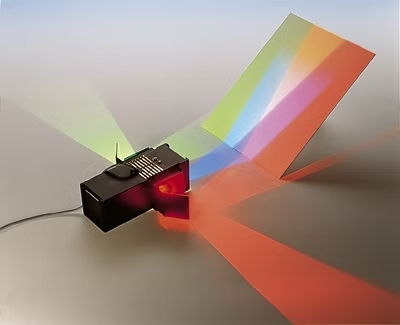
In the experiment on additive colour mixing, the students come
to understand one of important, technical process for producing
colour images.
They should first investigate the overlapping of two different
coloured light beams and then, in a further experiment, observe the
possibility of producing white light and secondary colours by
combining three additive primary colours - red, green and
blue.
With the observation of coloured shadows, one can, on the one hand,
review prenumbra formation on lighting a non-transparent object
with two separate light sources and, on the other, demonstrate that
both additive primary colours are contained in the secondary colour
region.
The experiment can be carried out with little effort and without
making great demands on the experimental skills of the students
when the accessories for colour mixing are available. In the
evaluation, the students are led to an understanding of the
important principles underlying the creation of a coloured
television picture. Here, the aid of the teacher is advisable. The
outcome of the experiment is, on the one hand, the understanding of
important phenomenain nature (spectral sensitivity of the human
eye) or in technology (colour television). On the other hand, the
experiment has, by its simple, effective structuring, an emotional
effect on the students.
Benefits
- Multifunctional light box - All-in-one: Can be used for geometric optics on the table, colour mixing and on an optical bench
- Extension with others sets at anytime, no additional light sources needed, recognition value for students
Tasks
How is a colour television picture produced? Investigate which secondary colours can be produced by different combinations of coloured light beams.
