 Service
Also part of:

Article no. 25307-88 | Type: Set

Principle
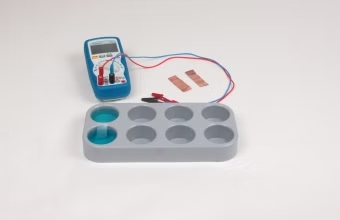
In a concentration series, the voltage is higher the greater the difference in the concentrations of the solutions in the half-cells. No voltage is measurable with a concentration series consisting of two half-cells which are exactly the same, e.g. copper electrodes in 0.1 molar copper sulphate solution. However, when ions (e.g. iodide ions) are added to one of the half-cells which form a sparingly soluble compound with the effective metal ions in the solution (e.g. Cu2+), then a part of the effective metal ions are lost by precipitation (iodide ions react with Cu2+ to form sparingly soluble copper(I) iodide). The result is the formation of a difference in concentration between the two solutions in the half-cells, whereby the voltage of the concentration series increases.
Learning objectives
- Influence of the concentration on the electrochemical potential
Benefits
- Easy teaching and efficient learning by using interactive experimentation PHYWE-Software
- Experiment is part of a complete solution set with experiments for the topic Electrochemistry matched with international curriculum: all topics are covered
