 Service
Also part of:

Article no. 25286-88 | Type: Set
Principle
The PEM electrolyser consists of a thin, proton-conducting, polymer electrolyte membrane (PEM). The two sides of this are each coated with a catalysing material and act as anode and cathode. The theoretical decomposition voltage of water is 1.23 V, but it is higher in practice because of losses in the electrolyser. In the electrolyser used here it is about 1.5 V. This voltage must be exceeded for water molecules to be decomposed to hydrogen and oxygen.
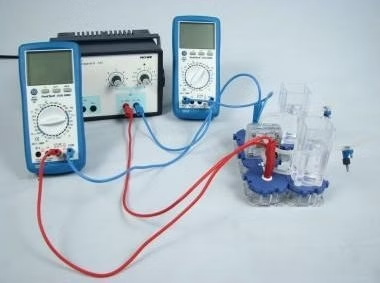
The current-voltage characteristic of a PEM electrolyser is to be recorded and examined in this experiment.
Benefits
- Experiment is part of a complete solution set with a total of 10 experiments for Renewable Energy fuel-cell technology
- The power supply used is versatile and is particularly suitable for pupil tests for all ages
- Doubled learning success: Electric circuit diagram on top, real components can be seen at the bottom
Tasks
When does an electrolyser start to work?
