 Service
Also part of:

Article no. 25276-88 | Type: Set
Principle
Objects in our environment possess different colours. In
addition they appear different in the light of evening sun than
when the it is high in the sky.
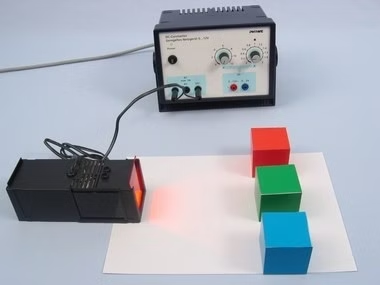
In this experiment, the students investigate how this everyday
phenomenon arises. On summarizing of their observations, the
students should discover that the colour of an object depends on
the colour of the illuminating light. The colour impression arises
because a particular part of the spectrum is reflected from bodies
and other parts absorbed. The colour of the object is produced as a
secondary colour by the reflected portion.
The prior conduction of the other experiments on colour mixing is
advantageous, because the students can then name the colour
component of the light from the filter more easily. Thus, they are
able to explain the observed phenomena. Conversely, this experiment
is also appropriate as an introduction and as a motivation to
consider colour mixing in more detail.
Benefits
- Multifunctional light box - All-in-one: Can be used for geometric optics on the table, colour mixing and on an optical bench
- Extension with others sets at anytime, no additional light sources needed, recognition value for students
Tasks
Why do objects have different colours? Illuminate objects with light of different colours and investigate the changes which take place.
