 Service
Also part of:

Article no. 15278-88 | Type: Set

Article no. 25276-88 | Type: Set
Principle
The goal of this experiment is that the students become
acquainted with special cases of the refraction of light at a prism
which are important in technical applications (optical instrument
construction). With the investigation and explanation of the light
path as a function of the position of the prism in relation to the
light source, knowledge about the laws of reflection and
refraction, as well as total reflection, are strengthened. In the
first part of the experiment, the normal refraction at a prism is
investigated (as a revision exercise); whereas in the second and
third parts of the experiment the possibility of employing a
right-angled prism at 90° or 180° to reverse the incident light is
recognised and understood.
It can also be recommended to take advantage of group
work: each group investigates the path of light with a different
position of the prism and, at the end of the experiment, the
results and the conclusions are collected for a total
result.
Benefits
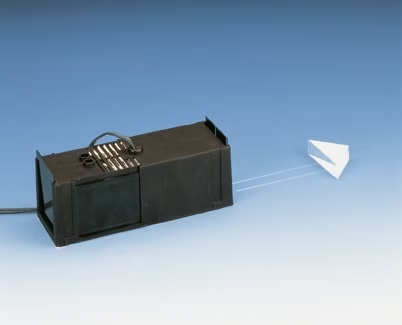
- Multifunctional light box - All-in-one: Can be used for geometric optics on the table, colour mixing and on an optical bench
- Extension with others sets at anytime, no additional light sources needed, recognition value for students
Tasks
Not all prisms are the same. Investigate the course of a light beam on emergence from a right-angled prism when the light - falls at an angle to the hypotenuse - hits a cathetus at right angles - is incident to the hypotenuse at right angles.
