 Service
Also part of:

Article no. 15278-88 | Type: Set

Article no. 25276-88 | Type: Set
Principle
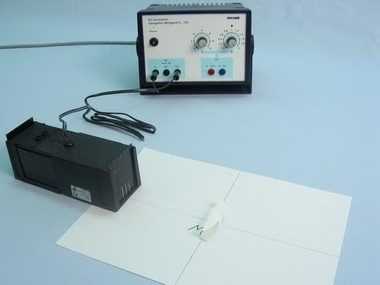
In this experiment, the students strengthen their understanding
of the light path through convex and concave lenses. By using a
step-by-step approach proceeding from planoconvex lenses via
planoconcave lenses to a combination of convex and concave lenses,
the students' experimental skills are further developed. The
observation of the refracted light beams and the qualitative
comparison of the position of the focal point makes the possibility
of making intentional changes in focal length with the aid of lens
systems clear to the students. In conjunction with the experiments
on lens defects, a good basis is laid down for gaining the basic
knowledge required for the understanding of many optical apparatus
(cameras, amongst others). This objective also helps in the
calculation of the focal length and refractive power of a lens
system in the evaluation.
The experiment is demanding in terms of the abilities and
experimental skills required of the students. Only with careful
adjustment of the respective positions of the blocks are consistent
quantitative results achieved.
Benefits
- Multifunctional light box - All-in-one: Can be used for geometric optics on the table, colour mixing and on an optical bench
- Extension with others sets at anytime, no additional light sources needed, recognition value for students
Tasks
What advantage do lens combinations offer? Determine the focal length of planoconvex lenses, biconcave lenses and various lens combinations.
