 Service
Also part of:

Article no. 15278-88 | Type: Set

Article no. 25276-88 | Type: Set
Principle
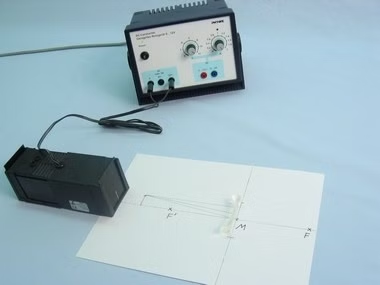
The aim of this experiment is to determine the intersection
point of selected light beams incident on a planoconcave lens and
thus demonstrate the possibility of image formation. First of all,
in this experiment, only the course of selected light beams is
observed. Only during the evaluation does the possibility of image
construction with the aid of the backward extension of the light
beams become apparent to the students.
In this way, a starting point is given for a discussion about the
role of mathematical aids in understanding physical phenomena. A
confirmation of the lens equation, in an example is not the least
important factor in making it clear to the students that a
significant advantage is given to the user when he can make precise
statements about the optical properties of its components even
before the construction of an optical apparatus.
In terms of the level of experimental skills and understanding
which are acquired by the students, the experiment is quite
demanding. No real image is produced, as the intersection point of
the backwards extension of the refracted light beams lies in front
of the planoconcave lens.
In this way, the teacher is given an opportunity to explain the
nature of virtual images to the students and to deepen their
understanding of virtual images on flat and curved mirrors.
Benefits
- Multifunctional light box - All-in-one: Can be used for geometric optics on the table, colour mixing and on an optical bench
- Extension with others sets at anytime, no additional light sources needed, recognition value for students
Tasks
Are images also formed by concave lenses? Investigate the image formed by a concave lens using selected light beams.
