 Service
Also part of:

Article no. 25289-88 | Type: Set
Principle
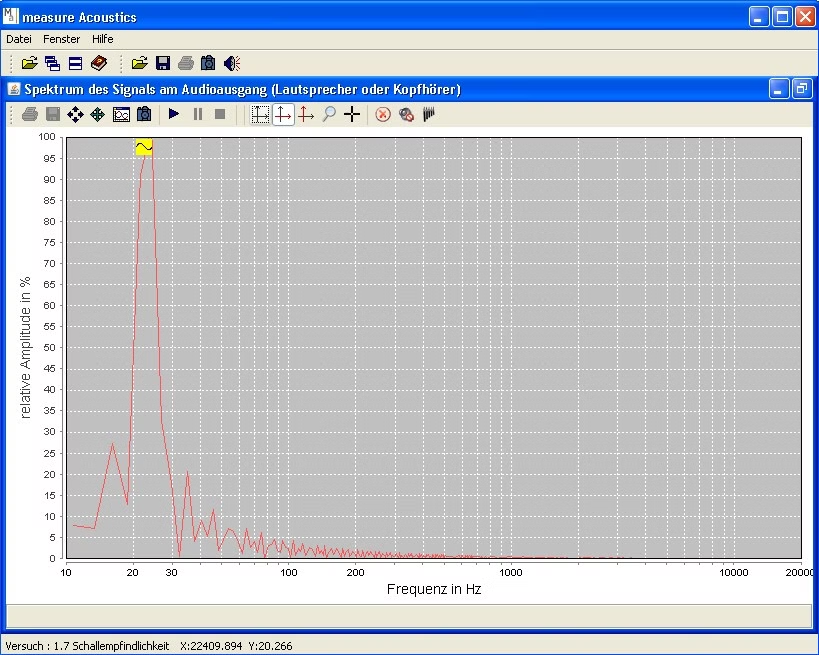
The human ear registers deep and high sounds as well as faint and loud sounds. Are there limits or can we hear any kind of high and deep sounds? In this experiment, the students learn that the human ear can perceive sound only within a limited frequency range. For this purpose, they determine their lower and upper hearing thresholds by generating sounds with the "measure Acoustics" software.
Benefits
- Experiment is part of an experiment set with a total of 22 experiments about generation, propagation and perception of sound, oscillations and waves
- Particularly appropriate as an experiment for first contact with physics in general
- With graphic student worksheets
- With detailed instructor information
- Optimized for tight schedules, i.e. minimum preparation time required
Tasks
Study this question by producing sounds of various different frequencies with the "measure Acoustics" software. Determine the deepest frequency that you can still hear (lower hearing threshold). Determine the highest frequency that you can still hear (upper hearing threshold).
Learning objectives
- Frequency range
- Lower hearing threshold
- Upper hearing threshold
