 Service
Also part of:

Article no. 25301-88 | Type: Set
A sewage treatment plant converts dirty waste water by mechanical and chemical-biological processes in clean water. One of these purification steps in sewage treatment plants is the aeration in the aeration basin. During this step oxidizable substances are oxidized by air and deposited as mud.
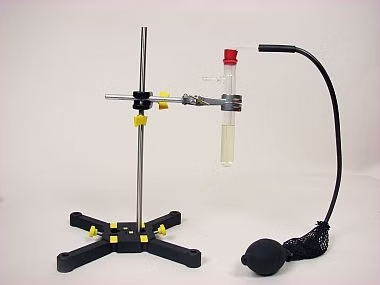
In this experiment this principle of aeration is examined. An air stream is passed through a ferrous salt-containing solution and students observed that the water-soluble iron sulphate is transferred by the air flowing through into an insoluble (oxidized) form. After this oxidazion the insoluble salt from the water can be removed by filtration.
Learning objectives
- Model of a sewage treatment
- Principle of aeration
Benefits
- Easy teaching and efficient learning by using interactive experimentation PHYWE-Software
- Experiment is part of a complete solution set with experiments for all Inorganic Chemistry matched with international curriculum: all topics are covered
