 Service
Also part of:

Article no. 25304-88 | Type: Set
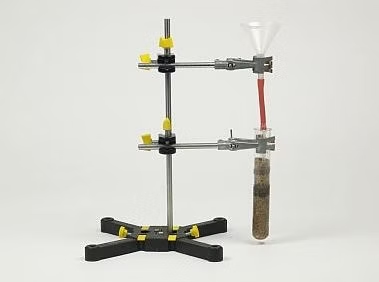
Petroleum collects in highly porous, spongy layers of rocks (e.g. sandstone) which normally contain water. Economically interesting petroleum accumulations are called oil fields. Below impenetrable layers, natural gas is found as the upper component, with petroleum below it and water underlying the petroleum. The search for oil fields concentrates on areas where the porous layers have their highest point (trap). The most frequent form of such a trap is a dome (anticline).
Discuss the formation of oil fields, there build-up and how they are exploited. In the discussion you should also cover the topic of energy supply and energy problems.
Learning objectives
- Petroleum deposits do not consist of lakes of oil, but of oil-saturated porous rock layers.
- These resulted from the (water) pressure which pressed the oil up against an impenetrable layer (stratum).
Benefits
- Easy teaching and efficient learning by using interactive experimentation PHYWE-Software
- Experiment is part of a complete solution set with experiments for the topic Organic Chemistry matched with international curriculum: all topics are covered
