 Service
Also part of:

Article no. 25287-88 | Type: Set

Article no. 25287-88D | Type: Set
Principle
A heat pump is a device which uses mechanical or electric energy
to pump thermal energy from a medium A into a medium B. The heat Q
conducted to the medium B is greater than the used mechanical or
electric energy E0. The Q factor (performance) of a heat
pump is described by the so-called "coefficient of performance"
ε = Q / E0. It is always necessary to
apply ε > 1.
The heat pump is known by the students as an important element for
alternative heat-engineering. In this industry, compression heat
pumps are primarily used.
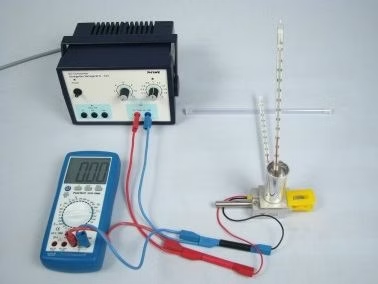
In this experiment a Peltier-heat pump is used. The most important
quality of a heat pump, that the coefficient of performance is
bigger than 1, is also valid here:
The heat pump delivers more thermal energy than utilized electric
energy, since it extracts heat from another medium (from the
surroundings). For this purpose, solar collectors or geothermal
energy, among other things are used.
In the experiment the water heats up while the aluminium block
cools down. Thus, the aluminium block takes on the function of the
surroundings.
Benefits
- Experiment is part of a complete solution set with a total of 17 experiments for Renewable Energy Basics and Heat energy
- Direct protection of the thermocouple against overheating due to fixed aluminum plates
- Additional aluminum block for storage of heat energy
Tasks
- Is it possible to generate thermal energy while converting electric energy?
- Determine the used electric energy and the produced thermal energy.
Learning objectives
- Heat pump
- Peltier effect
