 Service
Also part of:

Article no. 25287-88 | Type: Set

Article no. 25287-88D | Type: Set
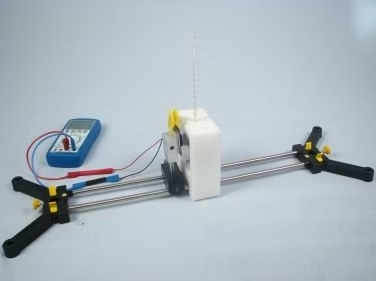
In this experiment a heated up room or house are to be
simulated. The solar collector from the Pupil Kit is used for this
purpose. Three walls are made up of Styropor, the front plastic
plate is the window. The black beaker with hot water serves as
"heater" of the room.
The thermal transfer through the wall has influence on the outside
temperature. The insulating properties of different walls can be
compared by measuring the outwall temperatures with each
other.
A correct temperature measurement of the outwall cannot be carried
out in this experiment. In the model the heater is very big in
comparison to the room, the thermogenerator touches the wall only
lightly and mostly leaves an air gap, thermal radiation also
contributes to the heating up of the thermogenerator
(Thermografie).
The measured thermoelectrical voltages are very small. However,
they show an obvious difference between the plastic plate and the
Styropor wall.
Benefits
- Experiment is part of a complete solution set with a total of 17 experiments for Renewable Energy Basics and Heat energy
- Versatile solar collector
- Stable setup by using the optical bench
Tasks
- Why are the walls of houses dammed with additional styropor plates?
- In this experiment the solar collector from the Pupil Kit is used as a model house. The walls are made up of styropor sheets. The transparent plastic sheet is the window. The thermal transfer through the wall and window are compared measuring the outwall temperatures.
Learning objectives
- Solar collector
- Heat insulation
- Thermogenerator
