 Service
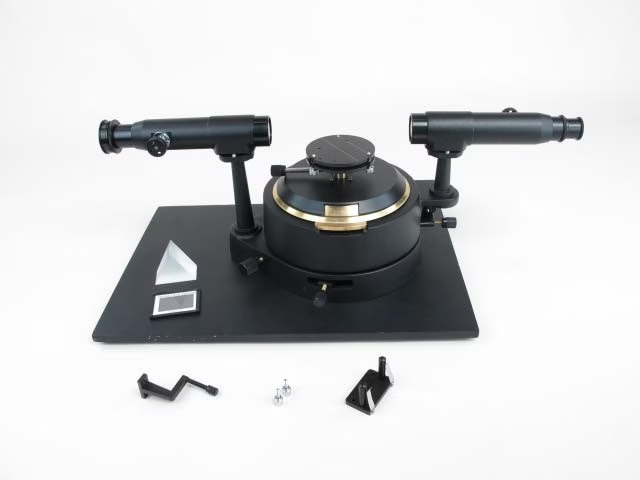
Function and Applications
The spectrometer can be used as both a grating spectrometer and a prism spectrometer. It enables the investigation of diffraction, refraction, and dispersion as well as the precise determination of wavelengths of spectral lines. Measuring spectra supports the understanding of atomic physics and fundamental principles of applied optics.
Benefits
- Can be used as a grating spectrometer and a prism spectrometer
- High measurement accuracy (up to 0.1 nm) for determining spectral lines
- Measurement of refractive indices, including liquids, using a hollow prism
- Fine adjustment drives for the table and observing telescope allow backlash-free angular settings with an accuracy of half arc minutes
- Adjustable entrance slit for adaptation to different light intensities
- Observing telescope with crosshair for precise angle and line measurements
Technical Specification
- Height of beam path above table: 180 mm
- Focal length: 178 mm (collimator telescope, eyepiece telescope)
- Eyepiece magnification: 15×
- Usable beam diameter: 32 mm
- Entrance slit width: 0…1.5 mm
- Table diameter: 85.5 mm
- Scale diameter: 176 mm
- Angular reading accuracy: 0°0′30″
- Compact device with graduated circle plate and two verniers
- Fine focus adjustment
- The collimator with adjustable slit is fixed in position
- Supplied including diffraction grating (600 lines/mm) with holder and flint glass prism with holder
- Grating: size (mm): 38 × 50; lines/mm: 600
- Prism: size (mm): 38 × 38 × 38; material: flint glass (n = 1.65)
Device name
Article no.
Digital learning

Necessary accessories
You cannot use the item without these accessories!
Device name
Article no.
Recommended accessories
With these accessories you can generate real added value
Device name
Article no.
Name
File name
File type
Digital learning
Free shipping from 300,- €