 Service
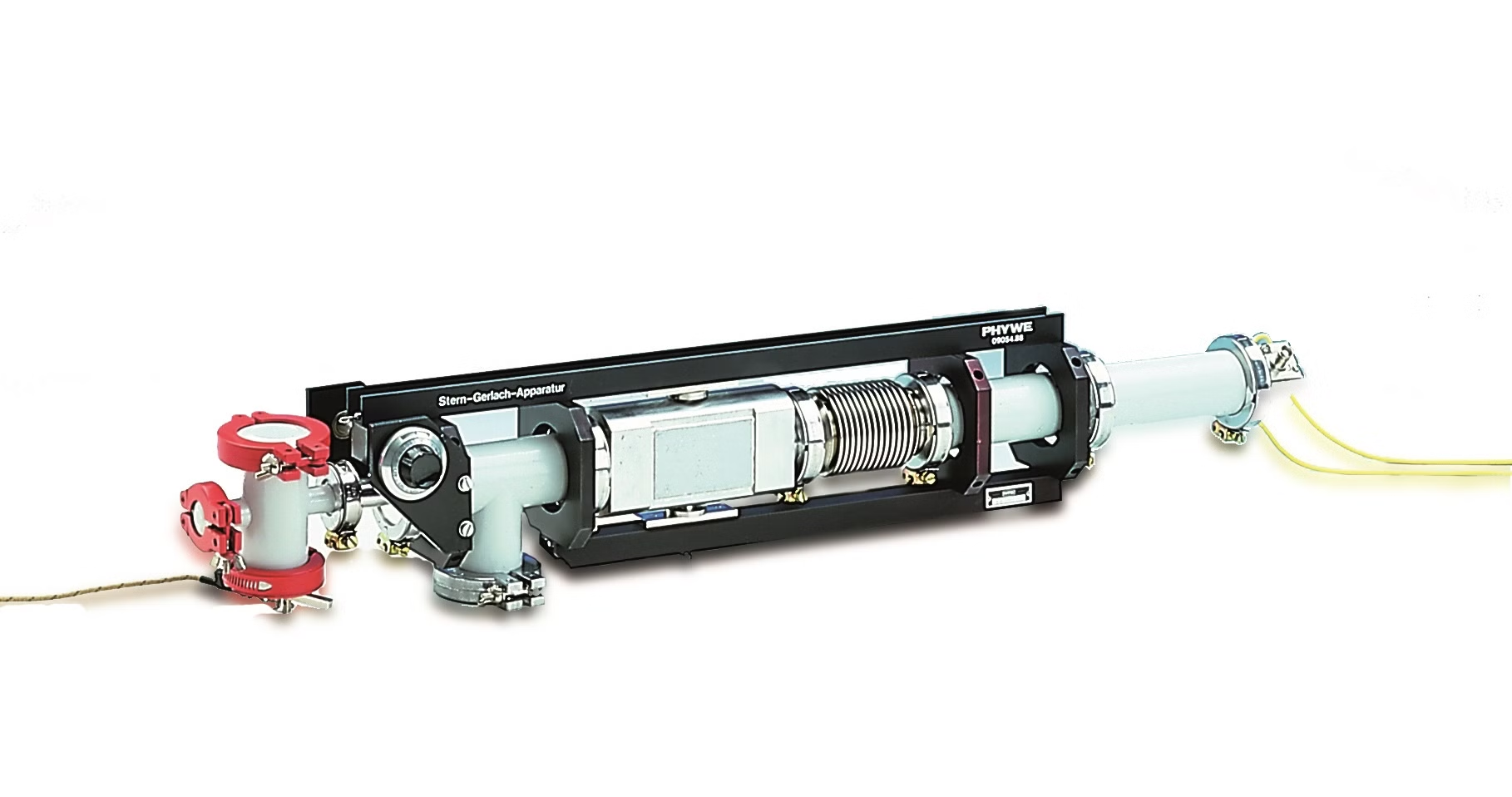
Function and Applications
The Stern–Gerlach experiment demonstrates that the spatial orientation of angular momentum is quantized. More than 100 years have passed since the experiment was first carried out by Stern and Gerlach. Today’s technical possibilities make it possible to perform this experiment using an apparatus that is both compact and easy to operate.
The Langmuir–Taylor detector consists of a glowing tungsten wire (approx. 800 °C) that ionizes incident potassium atoms, as their ionization energy is lower than the work function of tungsten. The ions are accelerated by an electric field towards a collector electrode; the resulting current is proportional to the number of incident atoms. By moving the wire transversely to the beam, the intensity can be measured as a function of position and magnetic field strength.
Benefits
The Stern–Gerlach apparatus from PHYWE offers the following advantages:
- Retention of the original measuring principle, implemented using state-of-the-art technology.
- Greatly simplified operation and handling.
- Clearly arranged setup.
- Easy adjustment.
- Illustrative results that are measurable and calculable.
- Highly sensitive detector.
- Potassium is particularly suitable, as it evaporates at low temperatures (< 200 °C) and deposits can be easily removed.
- The experiment is typically carried out at 10⁻⁶ mbar, allowing a significantly larger atomic beam and eliminating alignment problems associated with the historical experiment.
- Standardized flanges allow the apparatus to be opened and closed at several positions for experimentation as well as for cleaning and maintenance.
Technical Specification
The Stern–Gerlach apparatus is used in the Stern–Gerlach experiment (P2511101) and can be operated with the high-vacuum pumping station on a mobile table (09059-99).
The equipment of the Stern–Gerlach apparatus includes the following components with their technical data:
- Atomic beam oven
- electrically heated potassium evaporator with adjustment device and thermocouple
- Oven material: stainless steel
- Oven temperature: approx. 170 °C
- Thermocouple: NiCr–Ni (Type J)
- Atomic beam cross section: 0.5 × 4 mm²
- Langmuir–Taylor detector
- Electrically heated wire detector with collector, shielding cylinder and adjustment device
- Detector wire diameter: 0.25 mm, material: tungsten
- Operating temperature: max. 1000 °C
- The detector is pivot-mounted via a metallic bellows and vacuum-tight flanged to the analyzer
- Detector pivoting via precise lever guidance with micrometer adjustment
- Magnetic analyzer
- Specially shaped pole shoes made of magnetically soft pure iron, vacuum-tight installation
- Pole shoe length: 70 mm
- Pole shoe gap width: 2 mm
- Connection to vacuum pumping station via DIN nominal width 40 mm small flange
- Dimensions of the apparatus, height × width × depth (mm): 150 × 870 × 165
- Weight: 5200 g
