 Service
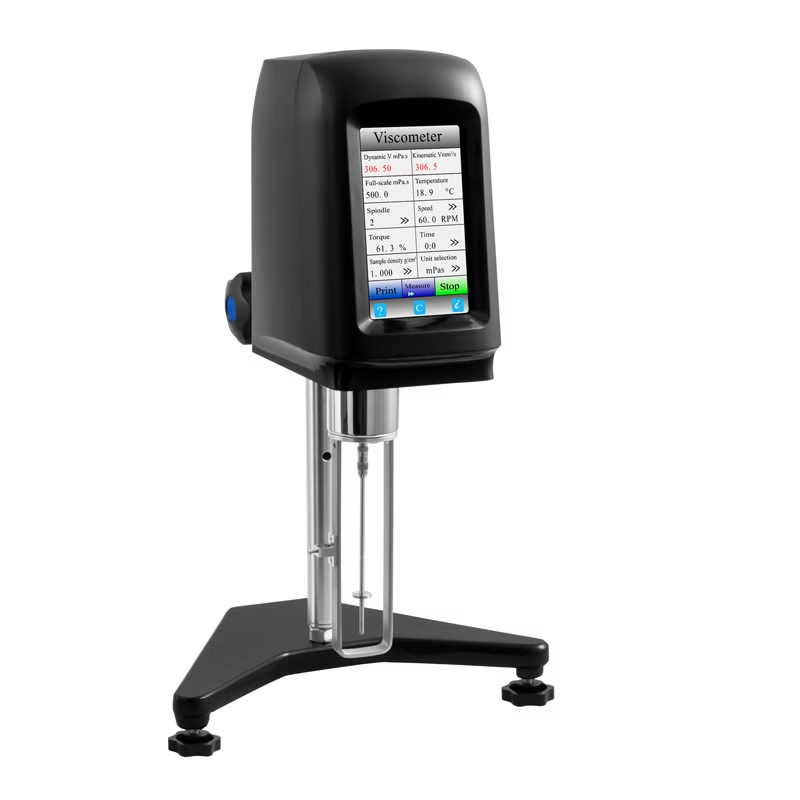
The viscosity of liquids can be determined with a rotation viscometer, in which a motor with variable rotation speed drives a cylinder immersed in the liquid to be investigated with a spiral spring. The viscosity of the liquid generates a moment of rotation at the cylinder which can be measured with the aid of the torsion of the spiral spring and read on a scale.
Benefits
- Classic experiment to determine the viscosity of a huge variety of fluids
- Watch all results directly on the built-in multilanguage display
- Use several spindles that come with a storage rack
- Wearless torque measuring system with high accuracy
- Digital speed control
- Interdisciplinary use also in applied sciences or physical chemistry
Tasks
- Determine the gradient of the rotational velocity as a function of the torsional shearing stress for two Newtonian liquids (glycerine, liquid paraffin).
- Investigate the temperature dependence of the viscosity of Castor oil and glycerine.
- Determine the flow curve for a non Newtonian liquid (chocolate).
Learning objectives
- Shear stress
- Velocity gradient
- Internal friction
- Viscosity
- Plasticity
Device name
Article no.
Quantity
Name
File name
File type
Digital learning
Free shipping from 300,- €