 Service
Also part of:

Article no. 15278-88 | Type: Set

Article no. 25276-88 | Type: Set
Principle
Spherical and chromatic aberration are the two most well-known
defects of image formation associated with a lens and whose
correction is achieved by incorporating expensive lens systems
(achromatic) in high quality optical apparatus.
For this reason, the students should investigate the colour
phenomena that appear when light is refracted by a convex lens in
this experiment. After the first experiment (large aperture
opening) in which the coloured margins of the cone of light can be
well observed, it is the goal of the subsequet experiments
(in which the light beams close to and far away from the axis are
used and their different degrees of colour splitting are seen) to
allow the students to understand the cause of the colour phenomena.
Therefore, at the end of the section 'Refraction by lenses',
opportunities are given to apply the law of refraction, as well as
observations on refraction at prisms, to new facts. On the other
hand, the opportunity is given in this experiment to observe that
white light is composed of different colours and that refraction is
a function of wavelength.
In conjuction with the investigation of colour splitting by a
concave lens, the possibility of correcting of lens defects with an
appropriate combination of convex and concave lenses can be
discussed.
Benefits
- Multifunctional light box - All-in-one: Can be used for geometric optics on the table, colour mixing and on an optical bench
- Extension with others sets at anytime, no additional light sources needed, recognition value for students
Tasks
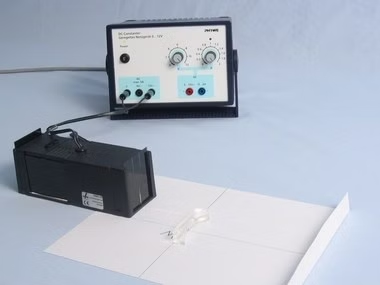
What are colour defects of a lens? Investigate colour splitting of white light following refraction at a planoconvex lens.
