 Service

Also part of:
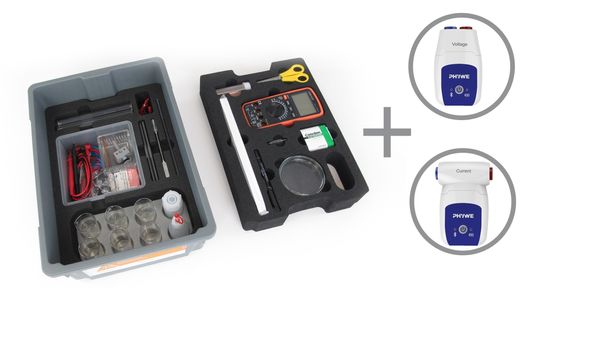
Principle
Just like metals, non-metals can also develop different solution pressures and therefore different potentials, as soon as they can form redox systems in suitable solvents. In many previous experiments, students have examined conventional galvanic cells in detail. In this experiment, students will learn that galvanic cells can also be made from non-metals.
Tasks
- Construct a simplified standard hydrogen electrode.
- Construct oxygen, chlorine, bromine, and iodine half-cells.
- Build galvanic cells from these half-cells.
- Measure the standard potentials of the resulting galvanic cells.
Learning objectives
Up until now, students have studied conventional galvanic cells in detail. In this experiment, they learn that galvanic cells can also be made from non-metals. Additionally, the concepts of reducing and oxidizing agents are examined.
Benefits
- This experiment is part of a complete set that covers all major curriculum topics in electrochemistry.
- Quick and easy experiment setup (instructions and risk assessment available).
Device name
Article no.
Quantity
Article no:
12901-02
1
Necessary accessories
You cannot use the item without these accessories!
Device name
Article no.
Recommended accessories
With these accessories you can generate real added value
Device name
Article no.
Name
File name
File type
Digital learning

Free shipping from 300,- €