 Service
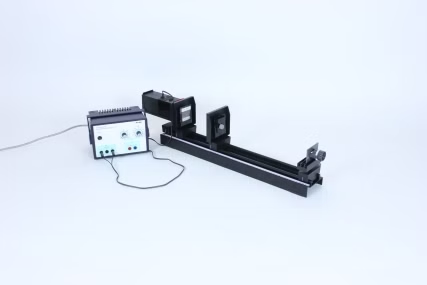
Principle
In an optical microscope a first image is created through the lens which is then viewed with the aid of the eyepiece. The laws of ray optics do not impose a specific !irre on magnification brought about by the Jens. However, since the Iight has wave properties, the theoretical magnifying power of the microscope is limited by diffraction phenomena. In transmitted-light microscopes diffraction from the object and the Jens must be taken into consideration. To keep the experiment simple, we have restricted it to the investigation of diffraction from the Jens. In fact, both diffraction components result in a similar resolving limit for the microscope.
The students should investigate to what extent the resolving
power of the microscope is dependent a) on the wavelength of the
Iight used and b) on the effective Jens diameter. The effective
Jens diameter is approximately simulated by the width of the
adjustable slit.
Benefits
- Multifunctional light box - All-in-one: Can be used for geometric optics on the table, colour mixing and on an optical bench
- Extension with others sets at anytime, no additional light sources needed, recognition value for students
Tasks
- Investigate to what extent the resolving power of a microscope
depends upon the wavelength of the light used and the diameter of
the lens aperture.
- Find out how resolving power, wavelength of the Iight used and
numerical aperture of the microscope are related.
