 Service

Technical data Electrolytic deposition and quantity of electricity (Faraday's first law)Article no: P1147501 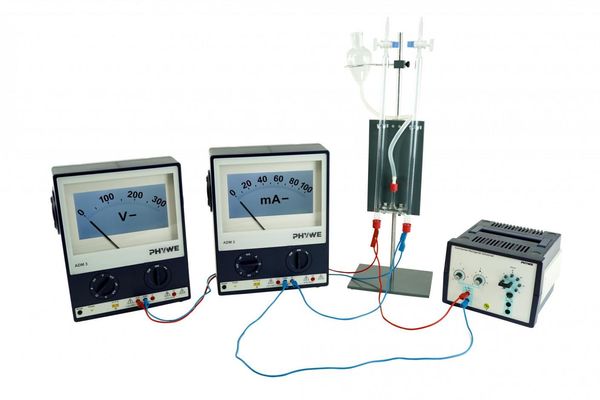
<!DOCTYPE html PUBLIC "-//W3C//DTD XHTML 1.0 Transitional//EN"
"http://www.w3.org/TR/xhtml1/DTD/xhtml1-transitional.dtd">
Principle During an electrolysis reaction, the deposited mass m of a substance is directly proportional to the flow of charge (First Faraday's law). The second Faraday law states that the electrochemical equivalents k (deposited mass per charge unit) behave like the equivalent masses (molar mass M divided by the valency z) of the elements. Both laws can be confirmed experimentally by water decomposition using an apparatus according to Hofmann.
Learning objectives
Scope of delivery
| ||||||||||||||||||||||||||||||||||||||||||||||||
PHYWE Systeme GmbH & Co. KG
Robert-Bosch-Breite 10 – 37079 Göttingen – Germany
www.phywe.com
Robert-Bosch-Breite 10 – 37079 Göttingen – Germany
www.phywe.com