 Service

Technical data Galvanic cellsArticle no: P1375300 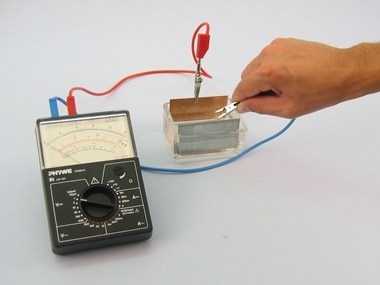
<!DOCTYPE html PUBLIC "-//W3C//DTD XHTML 1.0 Transitional//EN"
"http://www.w3.org/TR/xhtml1/DTD/xhtml1-transitional.dtd">
Principle In principle, a galvanic cell consists of two different metallic
electrodes which dip into an aqueous solution of an electrolyte. A
voltage is generated between the electrodes, whose origin can
be explained, in a simplified way, by the passage of positive metal
ions from the surface of the electrodes into
the solution. Consequently freely mobile electrons
are left behind on the electrodes. In this experiment, the students should become acquainted with the construction and mode of action of single cells which are frequently used in practice, but then are more complicated. Benefits
Tasks How can electric current be generated from chemical processes? Examine whether voltages are generated between two electrodes of different materials held in an aqueous solution of an electrolyte.
Scope of delivery
Necessary accessories
| ||||||||||||||||||||||||||||||||
Robert-Bosch-Breite 10 – 37079 Göttingen – Germany
www.phywe.com