 Service

Technical data Diffraction and Interference of MicrowavesArticle no: P2460903 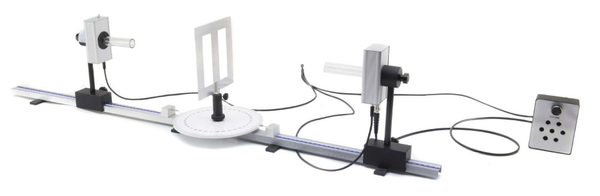
<!DOCTYPE html PUBLIC "-//W3C//DTD XHTML 1.0 Transitional//EN"
"http://www.w3.org/TR/xhtml1/DTD/xhtml1-transitional.dtd">
Principle If a double-slit is positioned in the divergent microwave beam, a characteristic intensity profile results behind this double-slit. The periodicity of the intensity profile can be used to determine the wavelength of the microwaves that are used. Benefits
Tasks First the phenomenon of diffraction through a single-slit and on a small obstacle is investigated. Then the intensity profile that results from a diffraction through a double-slit is measured and the wavelength of the electromagnetic wave that is used, based on this intensity profile, is determined. Learning objectives
|
PHYWE Systeme GmbH & Co. KG
Robert-Bosch-Breite 10 – 37079 Göttingen – Germany
www.phywe.com
Robert-Bosch-Breite 10 – 37079 Göttingen – Germany
www.phywe.com