 Service

Technical data The solubility products of silver halidesArticle no: P7401700 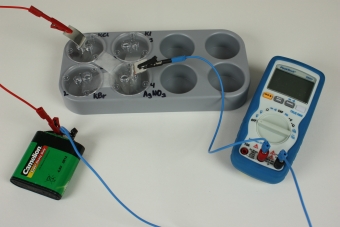 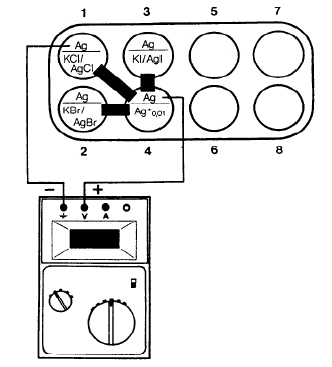
<!DOCTYPE html PUBLIC "-//W3C//DTD XHTML 1.0 Transitional//EN"
"http://www.w3.org/TR/xhtml1/DTD/xhtml1-transitional.dtd">
Principle When a few drops of a very dilute silver nitrate solution (c =0.01 mol/l) are added to a 1 molar solution of potassium halide solution (= KCl, KBr, KI), then there is an immediate precipitation of the corresponding silver halide (AgCl, AgBr, AgI), because the solubility product of these only very sparingly soluble salts is already exceeded even by these small amounts of added silver ions. Only that number of silver ions can remain free in these silver halide solutions, as are allowed to do so by the solubility product. As the relationship between the difference in concentration and the voltage in a concentration series follows the Nernst equation, the solubility product, or the silver ion concentration, of each silver halide solution can be calculated from the appropriate measured voltage.
Learning objectives
Benefits
Scope of delivery
| ||||||||||||||||||||||||||||||||||||||||||||||||||||||
Robert-Bosch-Breite 10 – 37079 Göttingen – Germany
www.phywe.com