 Service

Technical data Column chromatography - separation of leaf pigmentsArticle no: P3120300 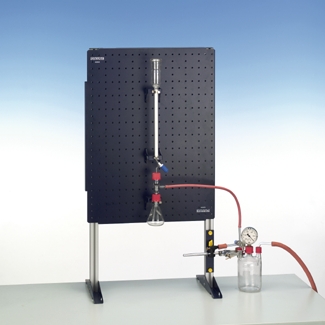
<!DOCTYPE html PUBLIC "-//W3C//DTD XHTML 1.0 Transitional//EN"
"http://www.w3.org/TR/xhtml1/DTD/xhtml1-transitional.dtd">
Principle In this investigation, a uniformly green raw extract of fresh leaves is first separated into different fractions by means of column chromatography. To do so, the extract is added to a column filled with starch and drawn through the column under slightly reduced pressure (to increase the flow rate of the mobile phase) with ligroin as the eluent. A separation occurs in a clearly recognisable, broad, yellow area and in a narrow, green band. This means that the xanthophylls (yellow) are separated from the chlorophylls (green). If the vacuum is reduced during the separation, the separation is much better, but then separation also takes considerably longer. Each of the separation fractions can be collected individually and characterised by recording their absorption spectra, if necessary, or examined for fluorescence by radiation with UV light. Benefits
Tasks Investigate different leaf pigments using column chromatography. Learning objectives
|
Robert-Bosch-Breite 10 – 37079 Göttingen – Germany
www.phywe.com

