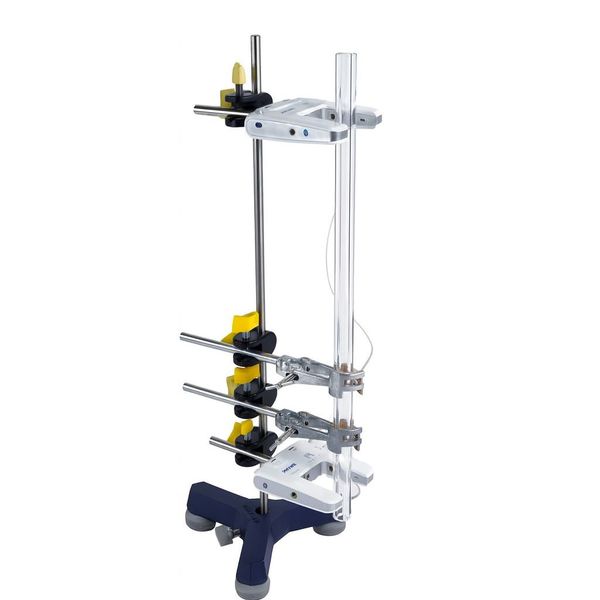

Principle
The mass of the metal cylinder generates a constant unidirectional force in the Earth’s gravitational field, which uniformly accelerates the body. Friction effects from air and the tube are negligible in the context of this experiment, as is the buoyancy of the cylinder caused by the surrounding air.
Tasks
- The students let a metal cylinder fall through a plastic tube and use two light barriers to measure the shadowing times for different fall heights.
- They calculate the initial and final velocity of the cylinder from the shadowing times.
- They analyze the measurement data for regularities that link the variables velocity and fall height.
Learning objective
In this experiment, students should determine the acceleration due to gravity experimentally and recognize that free fall is a uniformly accelerated motion.
Benefits
- Particularly clear and didactically prepared experiment description (with everyday relevance etc.) including protocol questions.
- Future-oriented teaching: integration into digital science education using tablets or smartphones.
- Increased student motivation through the use of the intuitive measureAPP.
- Improvement of media literacy.