 Service

Technical data Preparation of a simplified standard hydrogen electrode and measurement of some standard potentials with Cobra SMARTsenseArticle no: P7400869 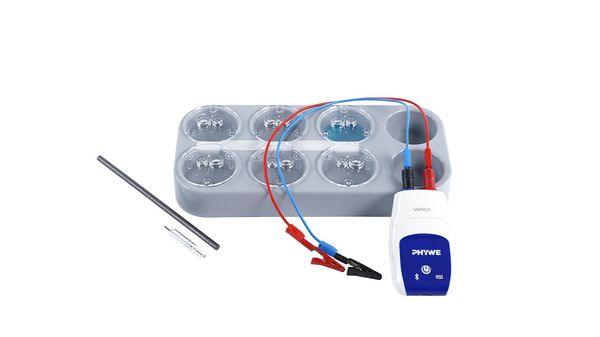 Principle A relative electrical potential can be assigned to each metal and other redox pairs if it is combined with a constant reference electrode in a galvanic cell. The so-called standard hydrogen electrode (SHE) was defined as the international reference electrode for this purpose. In the present experiment, a simplified form of this electrode is constructed and the redox potentials of various metals are determined experimentally. For this purpose, a platinum electrode is charged with hydrogen gas by electrolysis of a sulphuric acid solution. This hydrogen electrode is then successively connected to four half cells of different metals to form galvanic cells. The resulting voltages are measured and classified in a voltage series according to their magnitude and sign. The aim of the experiment is to illustrate the principle and structure of the standard hydrogen electrode and to deepen the understanding of electrochemical potentials. Tasks
Learning objective In the course of the experiment, the students will produce a simplified standard hydrogen electrode so that an understanding of its functional principle and structure is deepened. The term "standard potential" is also covered. Benefits
|
Robert-Bosch-Breite 10 – 37079 Göttingen – Germany
www.phywe.com