|
|
|
Technical data Connection of Daniell cells in series and parallel with Cobra SMARTsenseArticle no: P7400569
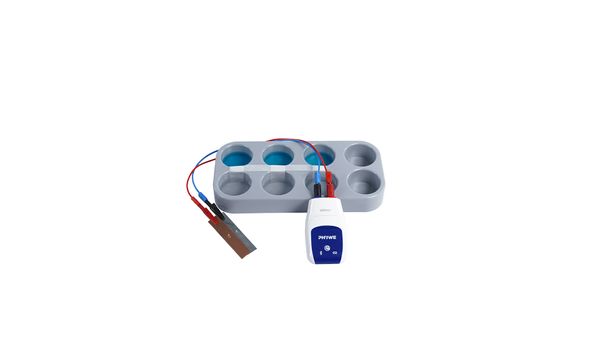
Principle A galvanic cell (Daniell cell) consists of two half-cells, in this case a copper sulfate solution with a copper electrode and a zinc sulfate solution with a zinc electrode. The zinc electrode decomposes while releasing electrons, whereas the copper electrode accepts electrons. Generally, only a small amount of current or voltage can be generated with a single galvanic cell. Connecting several galvanic cells, e.g., Daniell cells, in series increases the electrical voltage. The increased voltage corresponds to the sum of the voltages of the individual cells. In a parallel connection, no increase in voltage occurs. Tasks
Learning objectives In this experiment, students learn how to increase the efficiency of a galvanic cell by connecting them in series. The aim is to understand the relationship between the number of galvanic cells connected in series and the resulting voltage, as well as to recognize the differences compared to a parallel connection. Benefits
|
Robert-Bosch-Breite 10 – 37079 Göttingen – Germany
www.phywe.com