 Service

Technical data A remarkable source of electric current with Cobra SMARTsenseArticle no: P7400169 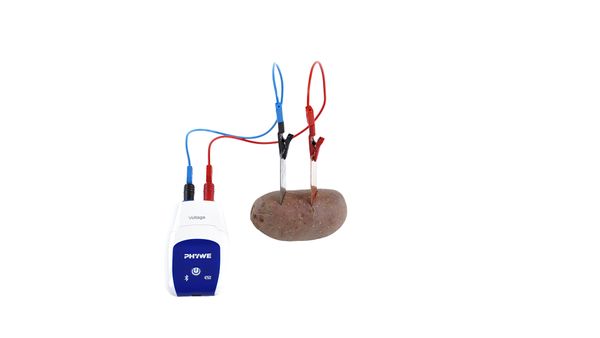 Principle In this student experiment, a so-called "potato battery" is created. When two metal plates made of different materials (e.g., zinc and copper) are inserted into a potato, a measuring device can detect an electrical voltage between the two metals. Tasks
Learning objectives In this experiment, students gain insight into electrochemistry and learn the basics of how a battery is constructed. They understand that the measured voltage results from the difference in the standard electrode potentials of the metals used and that this can be predicted using the electrochemical series. They also learn that a potato contains electrolytes, which are essential for the functioning of a galvanic cell. Benefits
|
PHYWE Systeme GmbH & Co. KG
Robert-Bosch-Breite 10 – 37079 Göttingen – Germany
www.phywe.com
Robert-Bosch-Breite 10 – 37079 Göttingen – Germany
www.phywe.com