 Service
Principle
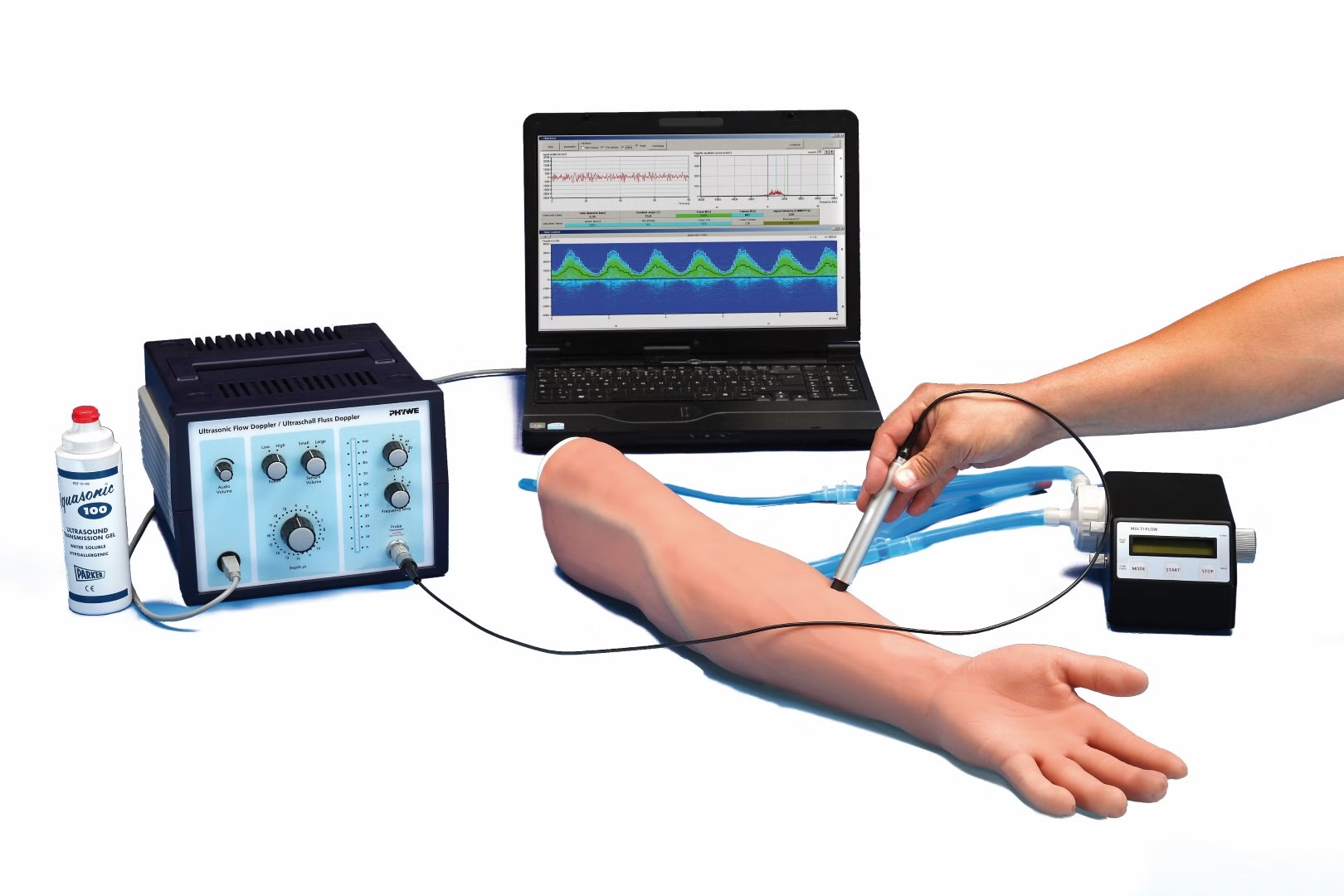
This set-up shows how blood flow studies are performed using Doppler ultrasound (Doppler sonograph). On a realistic arm dummy, the differences between continuous (venous) and pulsating (arterial) flow are shown as well as the difference in flow through a normal blood vessel and a stenosis.
Benefits
- Ideal experiment for medical students to learn the principles of Doppler sonography
- True to life with an arm model with blood vessels and stenosis
- Experiment components can also be used for other experiments relevant for medical students
- Display of measurement values as with a diagnostic system
Tasks
- Analyse blood flow and search positive and negative flow components. Explain the differences.
- Locate the built-in stenosis and compare the spectral distribution upstream and downstream of the stenosis.
- Examine and compare the three pulse modes of the pump.
Learning objectives
- Venous flow
- Arterial flow
- Stenosis
- Blood flow velocity tracings
- Frequency shift
- Doppler effect
- Doppler angle
- Doppler sonography
- Colour Doppler
- Continuity equation
Device name
Article no.
Quantity
Name
File name
File type
Digital learning
Free shipping from 300,- €