 Service
Also part of:
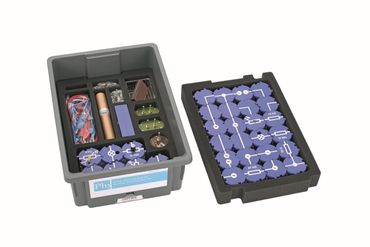
Article no. 25264-88 | Type: Set
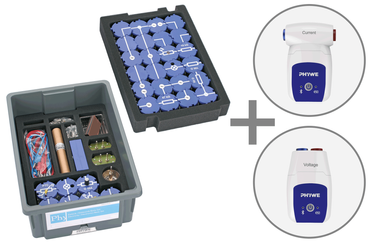
Article no. 25264-88D | Type: Set
Principle
Salts, acids and bases are electrolytes. In pure form they do
not (or hardly) conduct electric current, because in this condition
they have no (or only extemely few) freely mobile electrons. In
water, the dissolved electrolyte divides (dissociates) into
positive and negative ions.
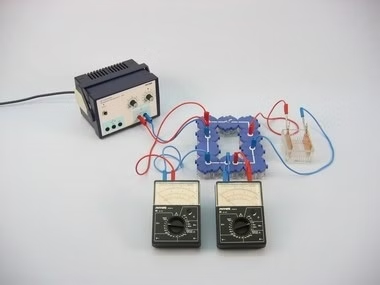
When voltage is applied to two electrodes which are dipped into an
aqueous solution of an electrolyte, the ions migrate towards the
electrode which has the opposite electric charge. Aqueous solutions
of electrolytes are therefore capable of conducting electric
current.
The students should find this out in this experiment, and also get
to understand why an electrolyte which is not dissolved (or not
melted) as well as distilled water are not conductive, or
hardly so.
Benefits
- No additional cable connections between the building blocks needed - clear arragned and quick setup
- Contact saftey due to puzzle blocks system
- Corrosion-free gold plated contacts
- Doubled earning sucess: Electric circuit diagram on top, real components can be seen unterside
Tasks
Do liquids also conduct electric current?
You will determine if water containing dissolved substances conducts electric current.
