 Service
Also part of:

Article no. 15278-88 | Type: Set

Article no. 25276-88 | Type: Set
Principle
This is a particularly important experiment in our series of
experiments dealing with the reflection of light because it
reinforces the students' knowledge of the laws of reflection by a
plane mirror and applies it to other situations. The first part of
the experiment stresses the observation of the path of parallel
incident light beams which are reflected by a concave mirror and,
in this context, the introduction of the term "focal point".
In the second part of the experiment, the paths of three
selected light beams are experimentally determined and thus
form the general prerequisite for the understanding of image
formation which is to be covered later.
The second part of the experiment is thus more demanding on
the abilities and experimental proficiency of the students.
The two experiments can be seen as a unit. However, each of
it can be performed separately; and in the interest of
careful performance and development of experimental proficiency we
recommend to do that.
Alternatively we can recommend an approach where each group of students investigates the path of a different selected beam of light; these results can then be pooled at the end of the experiment.
Benefits
- Multifunctional light box - All-in-one: Can be used for geometric optics on the table, colour mixing and on an optical bench
- Extension with others sets at anytime, no additional light sources needed, recognition value for students
Tasks
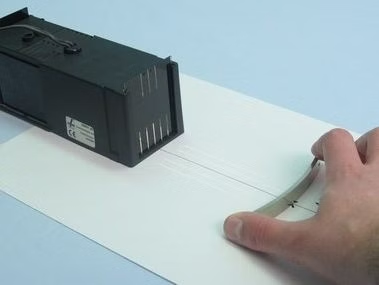
How is light reflected by a concave mirror? Investigate how light is reflected by a concave mirror and determine the path of selected light beams which are reflected by a concave mirror.
