 Service
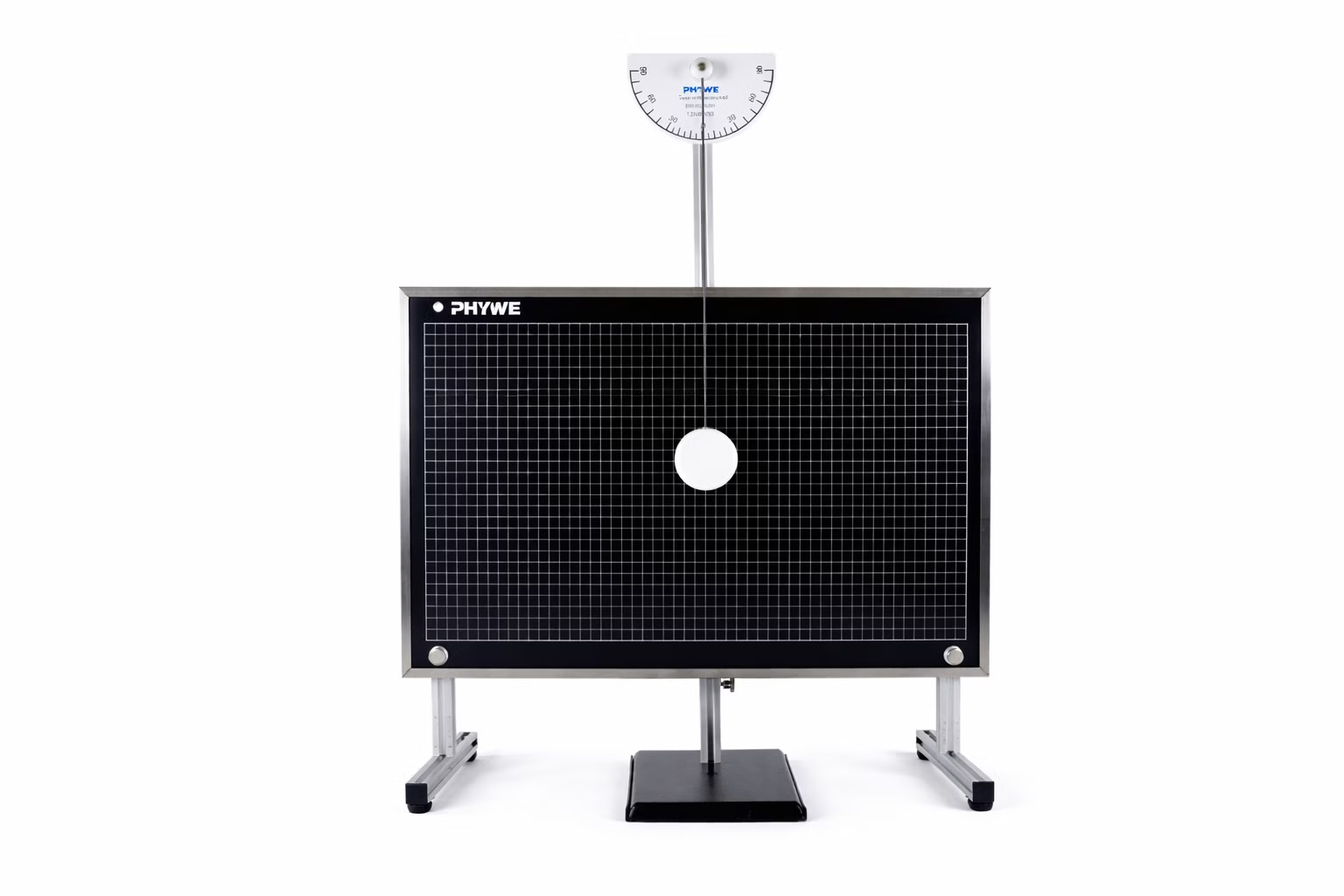
Principle
The pendulum is an idealized physical model in which the oscillating mass is considered as a point mass and the mass of the string is neglected. The motion takes place exclusively in a vertical plane without considering friction or air resistance. Under these conditions, the period of oscillation depends only on the length of the string and the acceleration due to gravity. A longer string results in a slower oscillation, while a shorter string leads to a faster oscillation. With DigiMotion, the motion is precisely recorded in real time, enabling the investigation of the relationship between pendulum length and oscillation period as well as the experimental determination of gravitational acceleration.
Tasks
- Set up a simple pendulum and set it into motion.
- Record the motion using DigiMotion and measure the oscillation period for a specific pendulum length.
- Repeat the measurement with several different pendulum lengths.
- Present the measurement results graphically and investigate the relationship between pendulum length and oscillation period.
- Determine the acceleration due to gravity from the analysis.
Learning objectives
Students recognize that the oscillation period of a simple (mathematical) pendulum is independent of its mass and depends solely on the length of the pendulum. They analyze experimental measurement data and establish a functional relationship between pendulum length and oscillation period.
Benefits
- Precise digital recording of the pendulum motion in real time
- Direct graphical analysis within the app
- Experimental determination of gravitational acceleration
- Promotion of mathematical skills through diagram analysis
- Ideal for use in lower and upper secondary education