 Service
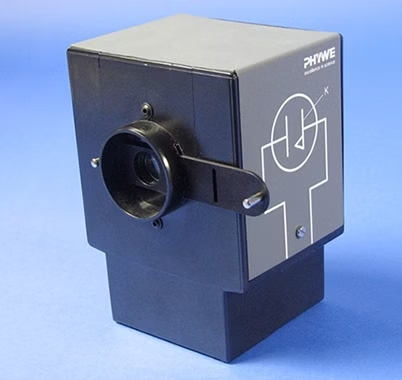
Function and Application
The photocell is used to investigate the photoelectric effect and for the experimental determination of Planck’s constant.
The vacuum-sealed photocell is safely housed in a plastic enclosure and equipped with a removable metal cover.
Benefits
- Robust and stable construction for precise laboratory experiments
- Three-position shutter: circular aperture, entrance slit, or closed, allowing flexible light control
- Aperture tube for the secure insertion of interference filters
- Housing base with holding magnets and a 6 mm threaded hole for easy mounting on the supplied support rod
Technical Specification
- 4 mm connection sockets
- Diameter of active area: 15 mm
- Wavelength range: 185–650 nm
- Maximum sensitivity at: 340 nm
- Cathode material: Cs-Sb
- Anode material: K-Sb-Cs
- Sensitivity: 110 µA/lm or 70 mA/W
- Maximum cathode current: 6 µA
- Maximum voltage: 100 V
- Operating voltage: 15 V
- Dark current at 15 V: 2.0 pA
- Cell capacitance: 2 pF
Device name
Article no.
Digital learning

Name
File name
File type
Digital learning
Free shipping from 300,- €