 Service
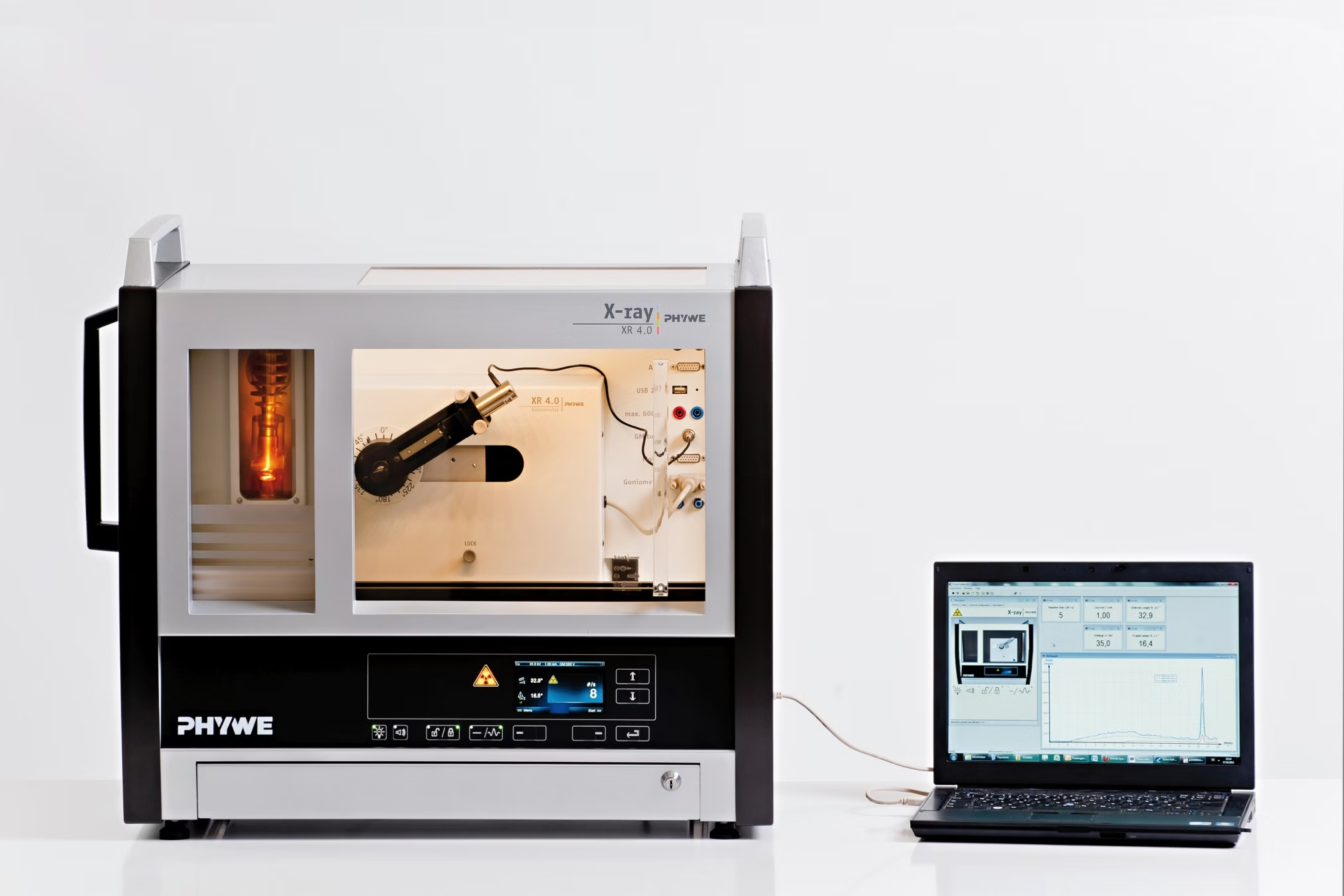

Principle
X-ray spectra are recorded as a function of the anode voltage. The short wavelength limit of the bremsspectrum is used to determine the agreement with the Duane-Hunt displacement law, and to determine Planck's "quantum of action".
Tasks
- Record the intensity of the X-rays emitted by the copper anode at various anode voltages as a function of the Bragg angle using an LiF monocrystal.
- Determine the short wavelength limit (= maximum energy) of the bremsspectrum for the spectra obtained in (1).
- Use the results to verify the Duane-Hunt displacement law, and to determine Planck's "quantum of action".
Learning objectives
- X-ray tube
- Bremsstrahlung
- Characteristic X-ray radiation
- Energy levels
- Crystal structures
- Lattice constant
- Interference
- Bragg equation
Device name
Article no.
Quantity
Name
File name
File type
Digital learning
Free shipping from 300,- €