 Service
Also part of:

Article no. 15350-88 | Type: Set
Article no. 15350-88D | Type: Set
Principle
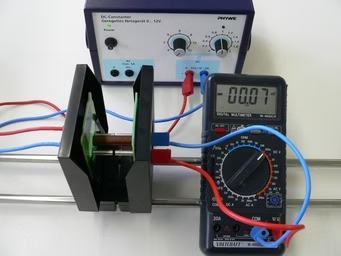
Performing this experiment is not difficult and it can be carried out in daylight as any light interference is shielded by the tube.
Benefits
- Specified for the requirements of the german final secondary-school examinations
- Especially for secondary schools
- Quantum and wave optics in a student experiment
Tasks
When is an LED a receiver? A light emitting diode or LED is an electronic semiconductor component. If a current flows through the LED in the conduction direction it emits light. Physically, semiconductors are characterised by a band gap, i.e. an energetically forbidden zone for electrons. This energy gap between the valence band and the conducting band essentially determines the electrical and optical properties. E.g. a photon whose energy is less than the band gap energy of the semiconductor cannot create an electron-hole pair. In this experiment you will determine the size of the band gaps of the LED relative to one other.
