 Service
Principle
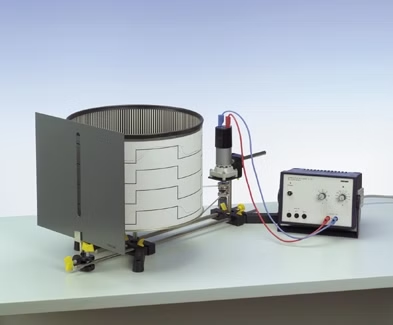
As in many technical processes, in the course of many biological functions the output values act back on the input values. With the many disturbing influences that affect biological systems, a feed-back reaction (control loop) of this type enables an equilibrium to be established (homeostatis). The components of a biological control loop (receptors, neurones, synapses, effectors) require a certain time for the transmission of a signal. This time between the onset of a disturbance (stimulus) and the reaction which it triggers is called the dead time. In this experiment the test subject follows a rectangular curve on a slowly rotating drum, using a felt-tip pen inserted into a slit. In a reaction test the dead time is determined.
Benefits
- Easy to operate experiment setup in behavioural physiology
- Experiment setup can be used for other experiments as well
Tasks
- Measurement of dead time in a reaction test.
- Analysis of the transient response.
- Determination of threshold frequency for stimuli.
- Study of the effects of noise and alcohol on reaction capacity.
Learning objectives
- Reaction capacity
- Strobe drum
- Control loop
- Feedback reaction
- Dead time
- Follow-through time
- Threshold frequency
- Homeostatis