(function () { function textOf(el) { return (el && el.textContent || "").replace(/\s+/g, " ").trim(); } function resolveItemUrl() { var match = window.location.search.match(/[?&]item=(\d+)/); if (!match) { return null; } return window.location.origin + "/a-" + match[1] + "/"; } function loadAccordion() { var url = resolveItemUrl(); if (!url) { return Promise.resolve(null); } return new Promise(function (resolve, reject) { var xhr = new XMLHttpRequest(); xhr.open("GET", url, true); xhr.onload = function () { if (xhr.status < 200 || xhr.status >= 400) { reject(new Error("item page " + xhr.status)); return; } var doc = new DOMParser().parseFromString(xhr.responseText, "text/html"); resolve(doc.querySelector(".phywe-item-accordion")); }; xhr.onerror = function () { reject(new Error("item page network error")); }; xhr.send(); }); } function parseItemBlocks(scope, withQuantity) { if (!scope) { return []; } var rows = scope.querySelectorAll(".itemslist .row.itemblocks"); var items = []; for (var i = 0; i < rows.length; i++) { var cols = rows[i].children; if (!cols.length) { continue; } var nameLink = cols[0].querySelector("a"); var numberLink = cols[1] ? cols[1].querySelector("a") : null; var item = { name: textOf(nameLink || cols[0]), mappedTo: textOf(numberLink) }; if (withQuantity && cols[2]) { var qty = parseInt(textOf(cols[2]).replace(/[^\d]/g, ""), 10); item.quantity = isNaN(qty) ? textOf(cols[2]) : String(qty); } if (item.name) { items.push(item); } } return items; } function fillTable(tableId, items, withQuantity) { var table = document.getElementById(tableId); if (!table || !items.length) { return; } var tbody = table.querySelector("tbody"); for (var i = 0; i < items.length; i++) { var tr = document.createElement("tr"); var nameTd = document.createElement("td"); nameTd.style.width = "80%"; nameTd.textContent = items[i].name; tr.appendChild(nameTd); var numberTd = document.createElement("td"); numberTd.textContent = items[i].mappedTo; tr.appendChild(numberTd); if (withQuantity) { var qtyTd = document.createElement("td"); qtyTd.textContent = items[i].quantity || ""; tr.appendChild(qtyTd); } tbody.appendChild(tr); } var wrapper = table.parentElement; while (wrapper && wrapper.className.indexOf("printtablediv") === -1) { wrapper = wrapper.parentElement; } if (wrapper) { wrapper.style.display = ""; } } function stepTitle(stepEl) { if (!stepEl) { return ""; } var titleEl = stepEl.querySelector(".card-header button div") || stepEl.querySelector(".card-header button"); return textOf(titleEl); } function setHeadline(tableId, title) { var headline = document.querySelector("#" + tableId + " .printtableheadline"); if (headline && title) { headline.textContent = title; } } function parseMedia(scope) { if (!scope) { return []; } var rows = scope.querySelectorAll(".itemslist .row.itemblocks"); var items = []; for (var i = 0; i < rows.length; i++) { var cols = rows[i].children; if (!cols.length) { continue; } var nameLink = cols[0].querySelector("a"); var fileLink = cols[1] ? cols[1].querySelector("a") : null; var item = { name: textOf(nameLink || cols[0]), mappedTo: textOf(fileLink || cols[1]), quantity: cols[2] ? textOf(cols[2]) : "" }; if (item.name) { items.push(item); } } return items; } function fillFromAccordion(accordion) { if (!accordion) { return; } var versucheStep = accordion.querySelector('[data-step="versuche"]'); var versuche = parseItemBlocks(versucheStep, false); setHeadline("print-versuche", stepTitle(versucheStep)); fillTable("print-versuche", versuche, false); var lieferumfangStep = accordion.querySelector('[data-step="lieferumfang"]'); var lieferumfang = parseItemBlocks(lieferumfangStep, true); fillTable("print-lieferumfang", lieferumfang, true); var zubehoer = accordion.querySelector('[data-step="zubehoer"]'); var sections = zubehoer ? zubehoer.querySelectorAll(".card-body") : []; var notwendig = []; var empfohlen = []; for (var i = 0; i < sections.length; i++) { var items = parseItemBlocks(sections[i], false); if (sections[i].querySelector(".text-red, .icon-warning-black")) { notwendig = items; } else if (sections[i].querySelector(".text-green, .icon-Mehrwert_black")) { empfohlen = items; } } fillTable("print-zubehoer-notwendig", notwendig, false); fillTable("print-zubehoer-empfohlen", empfohlen, false); var mediaStep = accordion.querySelector('[data-step="media"]'); var media = parseMedia(mediaStep); setHeadline("print-media", stepTitle(mediaStep)); fillTable("print-media", media, true); } function start() { var itemUrl = resolveItemUrl(); if (!itemUrl) { setTimeout(function () { window.print(); }, 2000); return; } loadAccordion() .then(function (accordion) { fillFromAccordion(accordion); }) .catch(function (err) { if (window.console && console.warn) { console.warn("Accordion konnte nicht geladen werden:", resolveItemUrl(), err); } }) .then(function () { setTimeout(function () { window.print(); }, 500); }); } if (document.readyState === "loading") { document.addEventListener("DOMContentLoaded", start); } else { start(); } })();
 

Technical data


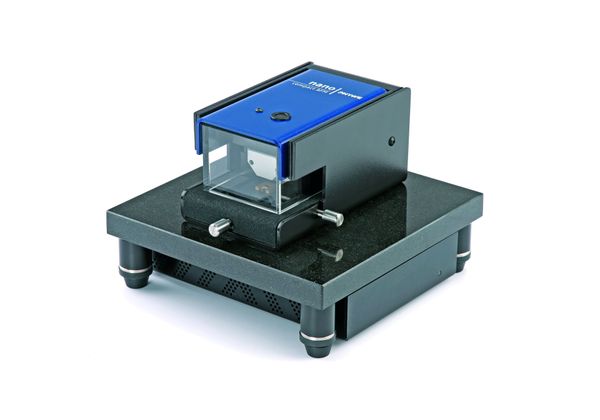
Compact AFM, Atomic Force Microscope
Article no: 09700-99

Function and Applications

Compact and easy-to-use atomic force microscope for imaging a wide range of micro- and nanostructures. Designed for teaching, laboratory courses, and research preparation in physics, chemistry, life sciences, and engineering.

Benefits

  • Compact all-in-one device, easy to operate and transport
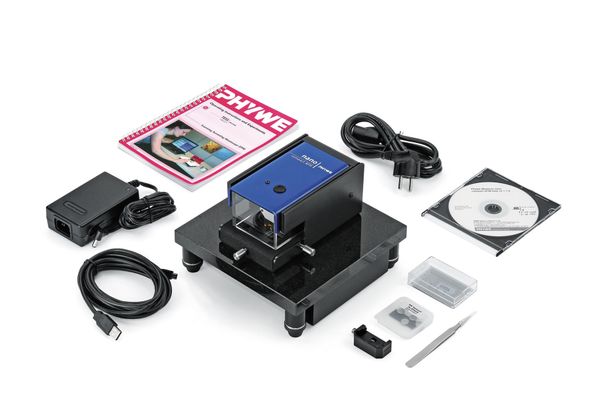
  • Complete solution including instrument, samples, probes, tools, and experiment descriptions
  • Automatic probe approach to prevent damage to probe and sample
  • Samples are easy to insert and replace
  • No laser alignment required
  • Research-grade system at about one third of the cost of a research instrument

Technical Specification

  • Measurement modes: contact, dynamic, phase contrast, MFM, EFM, basic spectroscopy (force–distance, amplitude–distance, voltage–distance)
  • Scan head with integrated control on vibration-damped base plate, 21 × 21 × 18 cm (L × W × H)
  • Folding mechanism for sample and cantilever access with automatic switch-off of sample illumination and automatic retraction of the scan head; transparent protection against airflow and sound; USB 2.0 interface
  • Tip-scanner AFM: linear, electromagnetic, low voltage
  • Maximum scan area: 70 × 70 µm² (XY dimension, 10% manufacturing tolerance)
  • Maximum Z range: 14 µm
  • Resolution X/Y/Z: 1.1 nm
  • Z noise level (RMS static mode): 0.6 nm
  • Z noise level (RMS dynamic mode): 0.5 nm
  • Automatic approach: vertical, up to 4.5 mm
  • Holder for standard cantilevers from various manufacturers with alignment grooves
  • Top-view camera: USB, 2048 × 1536 pixels, resolution better than 2 µm, digital zoom 1×, 2×, 4×
  • White LED sample illumination with automatic switch-off
  • Expandable to additional modes via optional upgrade packages
  • Extended instrument control via scripting/user interface access (LabView, VisualBasic, …)
  • Cantilever set: 4× contact mode, 4× dynamic mode
  • Sample set (6): carbon nanotubes, CD stamp, chip structure, skin cross-section, microstructure, dried Staphylococcus bacteria
  • Four empty sample holders for user samples
  • Tool set for mounting samples and cantilevers
  • Powerful software for measurement, analysis, and visualization (1D, 2D, 3D)
  • Manual with detailed operating and software instructions and five fully described experiments
  • Power supply: 100–240 V, 50/60 Hz
  • Plastic case with compartments for upgrade packages and side camera, 44 × 32 × 25 cm

PHYWE Systeme GmbH & Co. KG
Robert-Bosch-Breite 10 – 37079 Göttingen – Germany
www.phywe.com
Contact