 Service

Technical data Determination of molar mass using the ideal gas lawArticle no: P3010401 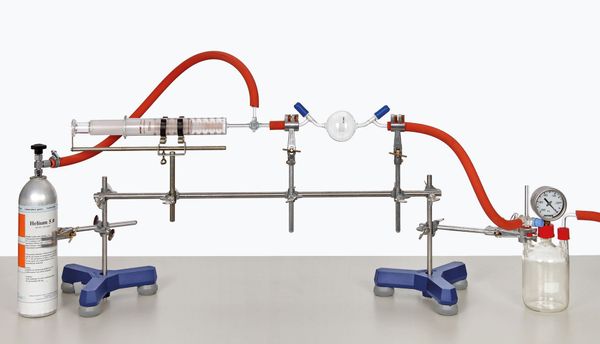
<!DOCTYPE html PUBLIC "-//W3C//DTD XHTML 1.0 Transitional//EN"
"http://www.w3.org/TR/xhtml1/DTD/xhtml1-transitional.dtd">
Principle All gases may be considered, to a first approximation, to obey the ideal gas equation which relates the pressure p, volume V, temperature T and amount of substance n of a gas. The amount of gas n is expressed as the number of moles and is equal to m / M where m is the mass of gas present and M is the mass of one mole of the gas. The volume occupied by a known mass of gas is to be measured at a given temperature and pressure, so that the ideal gas equation can be used to estimate the molar mass of the gas. Benefits
Tasks Determine the molar masses of the gases helium, nitrogen, carbon dioxide and methane. Learning objectives
Necessary accessories
|
PHYWE Systeme GmbH & Co. KG
Robert-Bosch-Breite 10 – 37079 Göttingen – Germany
www.phywe.com
Robert-Bosch-Breite 10 – 37079 Göttingen – Germany
www.phywe.com