 Service
Also part of:

Article no. 15350-88 | Type: Set

Article no. 15350-88D | Type: Set
Principle
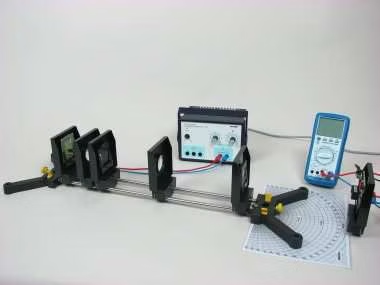
Care is to be taken in particular that the experimental setup is not shifted during the experiment, in particular the ruler because otherwise no reference point for the comparison of the measuring curves is available. Furthermore, this experiment has to be carried out in a completely dark room.
Benefits
- Specified for the requirements of the german final secondary-school examinations
- Especially for secondary schools
- Quantum and wave optics in a student experiment
Tasks
What does the spectrum of a light emitting diode look like?
When we observe the white LED through a grating we can see
colour components across nearly the entire spectrum. Because our
eye cannot see the individual frequencies objectively but
overemphasises the green range it is difficult to say which
intensities the individual colour ranges have. An absolute
comparative determination of intensity is hardly possible.
In contrast to our eye, the light sensor in the set measures the
light intensity very precisely and outputs a voltage proportional
to the incident intensity which can be measured with the
multimeter. This allows the spectrum to be measured and to
determine at which frequencies the individual LEDs have their
radiation maximum and what their relationship to each other
is.
In this experiment you will learn how to (objectively) measure the
spectrum.
